Showing posts with label movies. Show all posts

Wednesday, July 01, 2026

How I Fell Upstairs and Found God


I got super-annoyed by C.G.I. at the movies -- computer-generated-images -- back around the time super heroes were pretty much it, everywhere. Super heroes and tiresome fantasy. Supernatural hoo haw. Pop culture became lousy with C.G.I. gimmicks, imitations, wild flights of illogic and cheap, cheap story-telling (even though C.G.I. is super-expensive to produce). So I turned up my nose at the entire Marvel Cinematic Universe (MCU) when it was new and fresh. I wanted real human stories told about real, flawed human characters in adult situations. I'm no longer new and fresh myself, but I have Disney streaming anew, and no way was I not going to induce my second adolescence watching the MCU timeline unfold. Little did I know what I missed because of Pecksniffian snobbery.

I appreciate morally compromised characters, but I usually associate them with realistic interpretations of human life, not space-and-time epics. Don't we all actually prefer the self-involved to saints? I'm elated to find frequent divided minds among the super-heroes who gather under the rubric of "The Avengers." Bruce Banner is my living notion of ambiguity, always teetering between unchecked power and unchecked rage. Tony Stark can be a prancing egotist, but he also knows guilt intimately and unrelenting. Thor can't get over himself; he's as self-centered as Tony without the wit or god help us finesse. Captain America, Steve Rogers, is the most saint-like of the Avengers but sparks a civil war when he refuses to subordinate his power to the state by signing the Sokovia Accords. He's standing up for what he believes as a principled person, that big government has no business holding a super-hero's leash. We have to applaud that righteous puritan.

The best example of moral complication is the great MCU villain Thanos, played by Josh Brolin through a trio of films culminating in Avengers: Endgame. Brolin, despite the heavy masking required to make Thanos appear other-worldly, plays a towering, powerful villain and a character full of regret on how the world is destroying itself with runaway consumption. He's kind of a soured environmentalist. Thanos believes as sincerely in his own moral mission as Captain America believes in his. Both are prepared to sacrifice life to be true to themselves. Thanos quite righteously sacrifices his adopted daughter Gamora on the desolate planet Vormir, because to obtain the Soul Stone he's instructed to sacrifice someone he loves. Gamora is handy. In The Infinity War, Thanos snaps out the lives of half of all living creatures -- not just humans, but animals too (visually the filmmakers make people turn to blowing dust before our eyes. The disappearance of Peter Parker who's cradled wounded in Iron Man's lap is truly one of those scenes that'll sneak up on you at the movies and make your eyes water). Thanos becomes a mass murderer not out of hatred, not for conquest, but because he wants the blessed world to be sustainable. He sees overpopulation and greed as the only defining features of this world, and those greedy traits offend him deeply. Thanos dies believing in his own heroism. His death is melancholy for that very reason. We hate to see any soul, even a misguided one, face his own colossal failure.

The writers of the MCU universe explore all sorts of topics, like the wholly arbitrary and spiteful nature of divinity, particularly the god Odin who brooks no stubbornness. (Any resemblance to the angry God Jehovah of Christian nationalists would appear to be purely coincidental.) Thor is my least favorite Avenger, except when he gets dissolute. In the long run getting banished to Earth improved his character. Natasha Romanoff, the Black Widow (played by the sparkling but-seriously-don't-mess-with-her Scarlett Johansson) is my favorite, and her self-sacrifice (again on that awful planet Vormir) to save Clint Barton (Hawkeye) is another moment of terrible moral consequences derived from doing what's right.

Heroes are necessary bearers of culture -- every culture, every sub-culture, living now and in every time. Heroes transmit principles, sometimes the local gospel, often the illustrated moral decisions that keep societies and civilizations cohering. We need them. I fall back on something my friend Dalton George wrote on Substack:

"I'm of the mind that we have a biological inclination towards heroes. Our longest-surviving stories, art, and songs detail heroes. An individual is up against something much great than themselves, someone using their agency to benefit the community, country, and place. There's a reason Marvel movies are the cash cow they are. Brighter minds than mine have observed that our society is largely starved for heroes." 

I relish the idea that heroes arose from our very evolution through danger. We have to have heroes, and we'll create one on the spot if need be. But the Sokovia Accords were all about keeping unchecked power under scrutiny. Because otherwise giant ballrooms arise where once there was the law and duty and honesty and the good of the body politic. Heroes are not self-centered pricks.
 

Saturday, February 19, 2022

Abbie Hoffman Died of a Broken Heart


Whatever happened to Abbie Hoffman? 

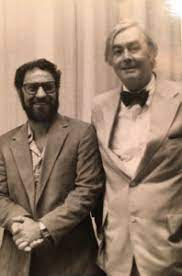
"Barry Freed" with Sen. Daniel
Patrick Moynihan, 1978,
at a Save the River event


You know Abbie -- '60s counter-culture celebrity, founder of the Yippies, self-described "action freak and anti-intellectual," jester to the American apocalypse, notorious for smoking dope when and where he shouldn't, and topping it all, he starred as the standout defendant in the trial of the Chicago 7 (particularly celebrated for his uncanny talent for giving a judge also named Hoffman the everlasting purple-faced shakes). Kurt Vonnegut called Abbie "a holy clown." He mobilized thousands -- probably millions -- of anonymous kids by teaching them how to challenge the power structure as a nobody. He also went underground for six years to avoid arrest, had plastic surgery to change his appearance (it didn't work), and yet even then, he couldn't stop himself from stirring the pot. Under the name Barry Freed, he organized Save The River in far upstate New York to stop the Army Corps of Engineers' plan for winter navigation on the St. Lawrence River.

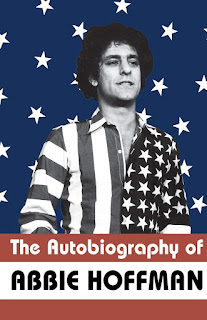
My friend who gives me interesting books that I never got around to reading decades ago in my actual youth when they were published -- he gave me Abbie Hoffman's autobiography. Abbie wrote it while he was hiding out from the authorities, between 1974 and 1980, and published it in 1980 under the title "Soon To Be a Major Motion Picture" (and BTW, why has there never been a movie biography of him? He deserves it as much as Che). The book was subsequently issued under the more mundane title, "The Autobiography of Abbie Hoffman."

What happened to him, you ask? I think he died of a broken heart.

As I started reading "Soon To Be a Major Motion Picture," I was skeptical. How well could this particular celebrity organize a self-examination and execute it with serviceable prose? But I was pleasantly surprised. In fact, I became engrossed for the entire 300 pages. Not only did Abbie write well, with wit and insight and a disarming honesty, but he also had a sort of cinematic instinct for painting a scene quickly and indelibly. I was reminded once again that it takes real smarts to play the clown. Abbie could write one-liners that opened universes of thought:

I recognized I had an ability to make outrage contagious. 
 
The put-on allows you to circumvent the trap.

 Nostalgia is a mild form of depression.

When decorum becomes repression, the only dignity free men have is to speak out.

 Free speech is the right to shout theater in a crowded fire.

When it comes time to clear away the dishes, only cowards stay seated at the table.


He never sold out. He never bent the knee to The Man, never joined the system and made lots of money, like Rubin the stockbroker and Hayden the upstanding young legislator. Abbie always lived on the economic edge. He could have cashed in. He got numerous offers to go the actor route, build a brand name, monetize protest as theater. He refused. He never stopped making speeches, leading protests, visiting college campuses (like AppState, which he did)-- until he went underground.

Never sold out, but did get depressed. The failed presidency of Jimmy Carter and the election of Ronald Reagan in 1980 got a lot of people depressed. By the time his autobiography was published, Abbie's noggin was going full bipolar, and he experienced wild periods of dissociation from the people who loved him, alternating between manic and immobilized spells. At one point he checked himself into a psychiatric facility under an assumed name. Finally, in 1989 he took 150 phenobarbital tablets and chased it with booze, ending what had been a flashdance of creative disturbance.

He called himself an anarchist, but he was actually always practicing a sly psychology:

I tried never to play on the audience's guilt, and instead appealed to feelings of liberation, a sense of comradeship, and a call to make history. I played all authority as if it were a deranged lumbering bull and I the daring matador. Well versed on the legal limits, I'd plant the sharpest banderillas I could dream up, reaching straight over the horns. I got nicked and whacked a jolly-good number of times but if you saw me, you would have said, There goes someone who loves his work. Impulsive and outrageous, the message was disruption.

But you can see disillusionment growing in him in the last 50 pages:

Fashions were changing. The "New Nostalgia" was in the air. In the introduction to the paperback edition of Woodstock Nation, I wrote (disparagingly) about the fifties revival, the self-analysis, the new religious fervor, body drugs like smack and Quaaludes (which helped you escape it all -- as opposed to the effect of mind drugs), and the absorption of the counterculture into the mainstream. Any call to idealism was greeted with choruses of "We've heard all that," and in a way I had too.

In a chapter titled ominously "Bummed Out on the Movement," Abbie spilled beans about the inherent sexism in a lot of hippie males and the dents they suffered in collisions with the new woman's lib; the neuroses of many a hanger-on who was using the anti-war crusade to work out personal problems; and the fracturing of unity between those who wanted to do bombs and those who wanted to do street theater. Abbie was always a pacifist.

I was still in the movement, but my heart was no longer in the fight. No matter what I did, someone bitched. Nothing I said came out right.

Abbie ended the autobiography with what purports to be a lengthy "confession" of sins. It begins:

On second thoughts....

Maybe I was wrong.

You know, I'm really sorry and I wanna come home. I love the flag. Blue for truth. White for right. Red for blood our boys shed in war....

And concludes:

...I realize I can't repair all the damage to our system I feel responsible for, but I'm willing to roll up my sleeves and give it a try. It's a damp underground.

Now can I come back?

Yes, the whole apparent show of penance is another put-on, at times hilariously so, but it's saturated with a palpable defeat, a consuming melancholy with the knowledge that you can kick a giant machine but the machine is gonna kick back harder. Sometimes things do get worse.

Abbie did come back from self-exile. He turned himself in soon after publishing this book and through a plea deal agreed to a year in prison. He served four months. After he got out, he continued giving speeches and doing some organizing, but the spirit had evaporated. It was the "Me Decade" now, and Abbie wouldn't last.


In the Future, We'll All Be Abbie Hoffman

I wasn't by any stretch a rep for the "counter-culture" in the '60s. I was straight as an arrow, trying to join the establishment as some sort of scholar/teacher of culture and history, but I was also draft-age and imbued as anyone with impulses for self-preservation, so I was "anti-war" and became an activist, though within the very political structures that Abbie was trying to demolish -- working inside the Democratic Party at the time, attending my first precinct meeting (of a legion still stretching to an unseen horizon) as a Gene McCarthy delegate. I dropped a seminar on Faulkner so I could volunteer full time for the McCarthy campaign, grew bitter when he lost but kept a toe in partisan political organizing, still believing that positive change was possible through the political process. Don't laugh. Abbie himself referred to the Gene McCarthy campaign as "a crusade of virtuous irrelevance." Ouch.

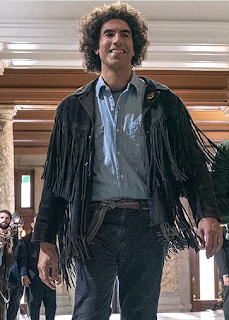
Sasha Baron Cohen
I didn't believe it at the time. But look where we've landed since 2016. The beast wants blood and is getting it, and I am sometimes at the threshold of a door that does on strange geometrical hinges. I feel for Abbie. I feel for all of us.


Abbie Makes the Movies Finally

Other than a cameo in Oliver Stone's "Born on the Fourth of July," Abbie had never been a character in any movie on the period -- let alone the center of his own story -- until Aaron Sorkin cast Sasha Baron Cohen to play Abbie in "The Trial of the Chicago 7." Cohen pretty much stole that movie from Eddie Redmayne, who played Abbie's nemesis Tom Hayden. Hayden was guilty in Abbie's eyes of being "absolutely without humor." According to Abbie, Hayden liked to stir things up and then take a quick exit before any shit hit the fan. In Chicago, Hayden didn't make his exit quick enough.

I think Sorkin's script captured both Abbie's talent for satire and his underlying whip-smart intelligence, his successful one-upmanship with Judge Hoffman, his actual maturity when compared to the arrested development of Jerry Rubin.

It's a pretty damn good movie.


Wednesday, December 29, 2021

Don't Look Up


What a movie for Christmas Eve! Season of hope and renewal, coinciding (more or less) with the Winter Solstice, when the sun decides to return to us, and Adam McKay's "Don't Look Up" proposes the sun won't come back. Ever.

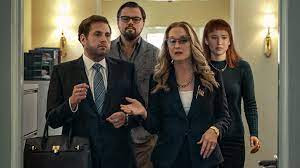
For an end-of-the-world movie, it actually delivers ... the end of the world. I sat there for the first two hours wondering if Adam McKay would actually do it. He did it. But the tone of the movie leading up to that "conclusion of the species" is so Adam-McKay-clever -- satiric thrusts and wicked jokes about how narcissism makes us dumb (this McKay World is ruled by a blond, trifling president, played pretty brilliantly by Meryl Streep, and by the Q Score of a varnished pair of TV anchors on a popular feature news show, "The Daily Rip" -- played by Cate Blanchett and Tyler Perry, having way too much fun) -- that biting tone of poking the bear of self-absorption did not entirely prepare me for the last 30 minutes, when McKay admits that human potential deserves reverence even as it faces its own extinction.

I was actually moved by Timothee Chalamet's performance as Yule, a skateboard dogtown boy with a hat turned around backwards ("I'm FirePuma142 on Twitch. Do you game?"), who turns out is possessed of a sweet disposition and a talent for praying a sincere prayer over a last supper. The moment absolutely floored me. The only Black character in the whole film (Rob Morgan as head of NASA’s Planetary Defense Coordination Office, a real thing) sits at the table and hears Yule's prayer. "You got some church game, man," he says. That scene could make you love the human race.

The ending of "Don't Look Up" moved me in unexpected ways. Leonardo DeCaprio nails the long arc of a serious academic astronomer of limited achievements who first discovers the trajectory of an Everest-sized meteor, who goes from the urgency of terror and a need to ride like Paul Revere to an unhorsed hanger-on seduced by his own celebrity (he officially achieves the status of an "A.I.L.F.," which you can translate for yourself; first word is "astronomer"). He redeems himself. His instinct at the end, when the end is inevitable because not one, not two, but three attempts to fly rockets to explode and divert the meteor have failed, he wants to go home to his estranged wife and his two teenaged boys, achingly good young men. At that last supper, he says to everyone, "We really did have everything, didn't we? I mean, when you think about it."

Chalamet in "Don't Look Up"


That's of course the message: gratitude for what we have could actually lead us to save what we have. More than just a ribbing about how stupid we are, "Don't Look Up" delivers a solution that still resides in our genes (alongside the gene for destruction), a capacity to love and to protect what we love.


FOOTNOTE

I could bend your ears a lot longer about other characters, other actors portraying them ... like Jonah Hill as the president's son, the little prick she's appointed nepotistically as her chief of staff, who gets the lion's share of funny lines. He's an idiot and doesn't know it. He talks like this when he wants to feign sympathy: "There's dope stuff, like material stuff, like sick apartments and watches, and cars, um, and clothes and shit that could all go away and I don't wanna see that stuff go away. So I'm gonna say a prayer for that stuff. Amen."

Or Jennifer Lawrence as the new-age doctoral student who first discovers the comet. She's got the big picture and does not get seduced by notoriety, but she's as buried in the petty details as everyone else. She discovers that an Army general has charged her for snacks meant to be free in the White House, and she will not let it go. It's as big an issue with her as the comet named for her.

Ariana Grande, hilariously cast as a self-absorbed pop star whose breakup with her boyfriend currently dominates social media and broadcast media too. One critic labeled Grande as "a good sport" for taking a role that could be seen as an unintentional self-parody, the young woman whose fame has throttled her maturity. This scene, where the Grande character, glitsy singer Riley Bina, sits in a TV greenroom with the two astronomers played by Jennifer Lawrence (as Kate Bibiasky) and DeCaprio, waiting to go on-air:

Riley Bina: You guys discovered a comet? That's so dope. I have a tattoo of a shooting star on my back.

Kate Dibiasky: Oh.

Dr. Randall Mindy: That's terrific. We heard about your breakup too, so we just wanna say... We're very sorry, right? We're real sorry. You seem like a... great person.

Riley Bina: Why don't you mind your own business, you old fuck?


RELUCTANT FOOTNOTE

I know that professional critics are divided on this movie. Some of the reviews have been unnecessarily savage, implying a smugness about McKay that I don't see and don't accept. If you can't hold a mirror up to current society without being accused of conceited motives, we've gone so brittle as a culture that we deserve to shatter.


Wednesday, April 22, 2020

Waco


April 19, 1993 -- another day that will live in infamy. The day that some 76 followers of David Koresh, including 25 children, died in an assault by the FBI on the Koresh sect's compound near Waco, Texas.

Just watched the Paramount Network's mini-series "Waco" (which is streaming on Netflix), and over 20 years of assumptions and FBI falsehoods have been sufficiently swept away. The series was based on two books, "A Place Called Waco" by Branch Davidian survivor David Thibodeau, and "Stalling for Time: My Life as an FBI Hostage Negotiator," written by the FBI's Special Agent in Charge of Negotiations Gary Noesner, so the series has the advantage of inside information for dramatizing what went on inside the compound during the 51-day siege and also what went on between Agent Noesner, who was trying to coax Koresh to give up, and the FBI command structure whose superior fire power was a big hammer looking for every nail.

The FBI doesn't come off well, but even worse in this presentation were the macho cowboys in the ATF, who launched the whole tragedy by initially raiding the compound with guns blazing on February 28. The ATF was fighting bad publicity over the previous Ruby Ridge fiasco, when an ATF sniper killed Randy Weaver's wife, and they were itching for some grand show of efficient law enforcement to recoup their image. They'd even hired a press agent, according to the mini-series script, and without question they fired the first shots at Mount Carmel which led to the gun battle that killed four ATF agents and wounded a dozen more. That battle sealed the fate of Koresh and his followers. Law enforcement was motivated by vengeance as much as by upholding the law.

David Koresh was no saint -- he was an egotistical and probably unstable self-appointed prophet who had decided that only he could have sex with the women while all the other men following him had to remain celebate -- but was he a dangerous cult leader (emphasis on dangerous)? Probably not. He was obsessed with the end of days and the Book of Revelation and was amassing small arms at his compound, which drew the interest of the ATF, but the FBI appeared to be lying when it announced that Koresh was planning a mass suicide. They also obviously lied when they claimed that Koresh was abusing the children in the compound.

Hostage negotiator Noesner had reached a deal with Koresh, allowing him time to write a manifesto about the end of time. Koresh promised to give himself up when he had his manuscript finished, but the writing -- like all writing -- took longer than expected. The FBI honchos in charge grew increasingly frustrated, and forced the reassignment of Noesner, and with the one calming personality  gone that Koresh would talk to, the FBI unleashed hell. It appears that a combination of tear gas and flash grenades pumped into the building caused the devastating fire, although the FBI apparently maintains to this day that the fire was set by suicidal Branch Davidians.

Friday, October 25, 2019

Forward My Mail To Brazil


Kevin Siers, Charlotte Observer
News broke late last night that Trump's "own Roy Cohn," Attorney General William P. Barr, has opened a criminal inquiry into the possibility that members of his own Justice Department, including the FBI, ginned up "the Russia hoax" out of personal, "deep state" animus toward his boss.

Trump needs fall-guys to blame, enemies to destroy (that's why he's all over Ukraine too), and he would most especially like proof of disloyalty about a select handful of government employees, starting with former CIA chief John Brennan and including Andrew McCabe at the FBI and Peter Strzok. Don't forget Comey. And throw in Mueller while you're at it. That's what he wants, that's what he demands. And by Gawd, and with the Good Lord's help, William P. Barr will finger 'em!

Never mind the rock cold fact that Robert S. Mueller III secured indictments of more than two dozen Russian military operatives for interfering in the 2016 election. He knows their names. He knows what they did. He knows the actual keystrokes they made on their computers in St. Petersburg to promote Trump and tar Clinton.

But never mind that. Twitterman has made it perfectly clear that he expects the Justice Department to be his battle axe against his political enemies. After all, they're guilty of "treason" -- how many times now has he used that exact word? A most threatening word, because you remember how we treat traitors.

From "Brazil," 1985


Mueller also said in that report you didn't read that he had “insufficient evidence” to determine whether Trump or his aides engaged in a criminal conspiracy with the Russians but that the campaign welcomed the sabotage and expected to benefit from it.

So when I heard Rachel unspool that Barr news at 9 last night, and then I sat down this morning to read the NYTimes story for myself, I kinda went to "Brazil" in my head. Terry Gilliam's "Brazil" in the 1985 movie of the same name. That "Brazil" is a head trip, a fantasy landscape of escape for our hero from an authoritarian and cruel government. The movie ends with the chief of the Department of Information Retrieval saying to the man doing the torture on our hero, "He's got away from us." And the torturer, holding a scalpel ready to slice, replies ruefully,  " 'Fraid you're right. He's gone." 

Escaped mentally. It's the only escape, the movie proposes.

Hence the 1985 movie poster:


Doesn't Trump and his big pug Barr make you want to take a head trip and never return?

Gotta fight that. Gotta keep my head in the game. Gotta keep up my resistance.

Sunday, February 17, 2019

Republicans Killed the Film Industry, But This Bill Could Help Bring It Back


Sen. Harper Peterson
A tax credit program for North Carolina film production helped build Wilmington into a major venue for film and TV production, with location work (and local jobs -- some 4,200 statewide) often spreading out all over the state including into these western mountains. In 2014 alone, film productions brought more than $300 million to more than 30 counties across the state. Then the Republican super-majority in the General Assembly, abetted by Republican Governor Pat McCrory, trash-canned the tax credits, then sealed the lid shut with HB2, and the film industry obliged -- "We know when we're not welcomed" -- and largely fled to Atlanta and other friendlier Southern states, taking their jobs and their cash with them.

Newly elected Democratic state Senator Harper Peterson of District 9 in Wilmington is trying to reverse that trend, though he doesn't expect much cooperation from his Republican brethren (who just naturally hate Hollywood or any group of different people who seem happy). Peterson introduced Senate Bill 57 to bring back the tax credits for film production, but he admitted that with the Berger/Moore people still in charge, he faces a strenuous uphill climb: “I don’t assume this will go forward, but it keeps the discussion alive and look at where we were when we were very prosperous.”

“I’m optimistic but I’m also realistic,” he said. “The industry is changing before our eyes. We have to reinvent and update the incentive program to meet the demands and competition from other states.”

Kudos to Senator Peterson for trying. At least the Democrats in the General Assembly are now on record as favoring job creation and bringing back an industry that the Republicans stabbed through the heart.

And don't we love seeing our state depicted on the big screen, as well as the little one?

Saturday, July 29, 2017

Seven Days in July

We must applaud those scamps over at AMC who're currently running "Seven Days in May," the 1964 political thriller that John Frankenheimer made about an attempted military takeover of the government of the United States. Great cast, great noir lighting, an edge-of-the-seat narrative, and a very interesting choice for AMC right now. A programmer over there might be making a comment on current events.

Back in "Seven Days in May" time, the treasonous General James Scott, head of the Joint Chiefs, sets up a military coup because a very unpopular nuclear arms treaty with Russia has been negotiated and signed by a very unpopular and weak president. The coup doesn't succeed.

Was the programmer at AMC thinking of the military generals who head several crucial arms of the Trump government? Those are arms of government, incidentally, with plenty of arms (if you catch my meaning). A Marine general just became Trump's chief of staff. Presumably, he'll be presiding over the central brain of the entire Trump administration.

A military coup today? What would be the trigger? Trump is soft on Russia like the president in "Seven Days in May," but that wouldn't do it. One too many irrational, dangerous decisions with direct impact on military personnel might, like, say, suddenly banning several thousand uniform service people because they happen to be transgender. Or ordering military operations that cause death because of stupidity.

Maybe all it would take would be a constitutional crisis wherein a general understood the fulsome danger to the Republic from an impulsive, authoritarian ignoramus?

Tuesday, November 10, 2015

The Corporation and the Captive Fish

    Greenwashing (a compound word modelled on "whitewash") -- a form of spin in which green PR or green marketing is deceptively used to promote the perception that an organization's products, aims, or policies are environmentally friendly.
    Sea World's announcement that it will discontinue its killer whale shows in San Diego is classic greenwashing. The corporation still intends to continue breeding killer whales in captivity. The corporation still intends to continue keeping those highly intelligent and family-oriented animals in concrete troughs, isolated from their natural family units. The corporation still intends to continue exploiting them for profit. The corporation is an unreconstructed dick.
    The corporation makes its supposed "reform" under severe pressure. The 2013 documentary Black Fish moved the public against Sea World's cruelty, which has ended in death and injury for some Orca trainers because the conditions of captivity actually make some killer whales psychotic.
    Sea World stock has plummeted. Ticket sales at San Diego have flat-lined. The paying public has decided they don't like this corporation and the way it's making money.
    What gives away the greenwashing is that while the company announced no more Orca shows at Sea World San Diego (by 2017, mind you), the company remained mute about identical Orca shows at Sea World San Antonio and Sea World Orlando, where protests have been more muted. No more Orca "shows," the company told its investors; now they're gonna have an "orca experience."
    Seriously? If there ever was a distinction free of any actual difference, it's that promise.

Wednesday, September 09, 2015

NC Senate Caves (A Little) on Film Incentives

Having done what they bloody well could do to drive filmmaking out of North Carolina (mainly sending it to Atlanta), with all its associated economic benefits (which were plenty!), the Republican numbskulls in the NC General Assembly announced yesterday that their utter failure at a "Film Grant Program" would be tripled in the new budget to $30 million, no matter what else happens to the future of public and higher education and teachers' salaries in this swirling-down-the-drain state.

The Republican grandees in the General Assembly had gotten nothing but bad press about the decamping of TV show after TV show, which have been shaking the dust of North Carolina off their designer boots and heading for friendlier territory since last year.

The $30 million may help, though it's still paltry peas compared to where we were before this radical right-wing bunch took over this once progressive and economically vibrant state.

Tuesday, January 20, 2015

NC Republicans to Hollywood: Drop Dead

The axing of North Carolina's film incentive program is costing us jobs, and more than just the jobs for the crews and the support staffs, it's costing small businesses BIG TIME.

Just announced: the Fox television production of "Sleepy Hollow" has announced that it will move to Atlanta for its third season (assuming it has a third season).

Where Hollywood goes for its on-location filming, local small businesses benefit. When "The Winter People" filmed in Avery County back in the 1980s, local antiques dealers sold props to the production. The making of Michael Mann's epic, "Last of the Mohicans," in the 1990s benefited more antiques dealers as well as hundreds of local people who worked as extras.

Here's a partial list of small businesses which profit from local film production:
Printers and Sign Manufacturers
Florists/Plants sales
Restaurants and Caterers
Hotels
Window Coverings
Event Rental Services (tents, etc.)
Photographers
Videographers
Physicians
Camera and Lighting Equipment
Heavy Machinery
Car/Van Rentals
Security and Locksmiths
Hardware/Lumberyards/Paint
Medics/Police/Firefighters
Antique Dealers
Teachers/Tutors
Marine Services
Artists
Calligraphers
Garbage/Recycling
Mobile Restrooms
Aerial Services
Hollywood deals in cash money and generally doesn't waste time haggling. But the economic geniuses in the NC General Assembly wanted Hollywood gone. And it's going.

Gee, thanks, Governor McCrory, for signing that bullshit legislation.

Friday, January 02, 2015

Happy New Year From the Good Hands People in the NC General Assembly!

New Republican laws that went into effect yesterday seem actually designed to lose jobs in North Carolina while transferring more wealth to the corporations.

The "restructuring" of movie incentives is already sending TV and film shoots into other states, like deepest Georgia, according to WRAL.

While the corporate tax rate is dropping from 6% to 5% as of yesterday, the Raleigh honorables shifted more of the tax burden to the rest of us in the form of a new fuel tax on vehicles that run on natural gas. Gee, thanks! Tax collections in the state are already $190 million "short of projections as of December," and since the richest among us will pay less, your average Joe Blow will get stuck with the slack.

All of us get stuck.

Wednesday, August 27, 2014

Okay, You Got My Attention

This morning I've been reading reviews on Rotten Tomatoes of "Pandora's Promise," a documentary on nuclear energy by filmmaker Robert Stone that we watched yesterday. It makes the case that much of what we've been told about nuclear energy is hyped-up fear-mongering and that nuclear is the safest and cleanest alternative to the poison of fossil fuels, particularly coal.

But ... Robert Stone? The guy who made the first Earth Day film? The guy who did the anti-nuke film "Radio Bikini" about the A-bomb tests at Bikini Atoll. He's changed his mind about nuclear energy, as have Stewart Brand, founder of the Whole Earth Catalog, and a number of other well known environmentalists who are interviewed in "Pandora's Promise."

Three Mile Island, Chernobyl, Fukushima ... the major nuclear disasters of our era, the names that send a chill down spines, and the Exhibits One, Two & Three for why nuclear energy is unsafe, unwise, and deadly. Stone faces those negatives head-on, goes to all three locations and tests the radiation levels with those little yellow monitoring devices.

Famous anti-nuke activist and liberal hero Helen Caldicott claims that 1 million people died at Chernobyl and that there's been a massive cover-up, for which no evidence exists. Pretty hard to cover up 1 million dead bodies. For sure, 50 people did die almost immediately at Chernobyl, and rare cancers will likely take others as the years advance. But compared to deaths directly linked to respiratory ailments linked to air pollution caused by fossil fuels ... well, you can make up your own cost-benefit analysis of nuclear power vs. fossil fuels. Wind and solar -- "renewables" -- aren't even on the playing field and likely never will be.

A younger generation will have to decide our direction, and the ones I've talked to since yesterday don't even seem to know that being anti-nuclear is supposed to be a birthmark of liberalism. Only conservatives are supposed to be pro-nuclear energy, but perhaps that's breaking down, and perhaps it should.

Stone proves that at least some of the anti-nuclear chatter has been gleefully propagated by the oil and gas industry, that the newest generation of nuclear reactors cannot melt down (Chernobyl didn't even have a containment building and Fukushima was old technology positioned on the assumption that no tsunami would ever reach higher than three meters). If I believe Robert Stone, I get a higher dose of natural radiation on a transcontinental plane ride than I would get standing next to a modern nuclear reactor.

I found "Pandora's Promise" a challenging and thoughtful film. You might too.

Saturday, August 23, 2014

North Carolina Is Being Run By Stupid People

The North Carolina General Assembly -- bless their (tiny, desiccated) hearts and their (total lack of) vision -- ended the incentive program that had built the film industry in North Carolina to the third largest in the whole country.

They instead put in a puny, emasculated incentive that The Hollywood Reporter called "nearly useless." Turns out the NC GOP hearts polluting industries (coal ash, anyone? how about fracking?) far more than they heart a non-polluting, jobs-creating industry like motion pictures.

“It’s disappointing,” the Motion Picture Association of America said in a statement Thursday, “that the new grant program included in the budget agreement will prevent North Carolina from remaining competitive in attracting this prominent source of in-state economic activity.”

And then there's this:
Spokespeople for ABC, CBS and Fox could not confirm their plans, but one studio executive said: “It definitely doesn’t bode well for future new production there, or for the terrific infrastructure of production, personnel and vendors they’ve built up in the state.”
In North Carolina, the first term Gov. Pat McCrory and the Speaker of the House Thom Tillis — a candidate for Senate —had both been vocal backers of film incentives until recently. However, as the state has seen a number of conservatives, Libertarian and Tea Party candidates elected, they have shifted to either a neutral position (the governor) or opposition (the speaker).
One big reason the North Carolina incentive legislation failed is because the Koch Brothers-backed nonprofit Americans for Prosperity bought radio commercials as the debate was going on that slammed film incentives. The ads were part of a larger campaign to eliminate a range of state-funded development programs.
"The money coming in from the outside has hurt the North Carolina programs for business development," said Rep. Susi Hamilton, a Democrat who fought to retain incentives. "The Americans for Prosperity spent a lot of money to try and end the program and unfortunately they have the ear or our leadership and appear to be successful."
ADDENDUM
From BlueNC this morning:
CAROLINA COMBACK’ OR ‘NORTH STATE STAGNATION?’ -- There’s hardly a road-side vegetable stand or machine shop that opens in North Carolina these days that Gov. Pat McCrory and his Department of Commerce don’t seize the opportunity for a news release or ribbon-cutting to announce new job creations. It’s seemed McCrory announces new jobs in the 10s or 20s while South Carolina announces them by the thousands. In the two years that McCrory’s been in office, even with the tax cuts enacted specifically to attract more industry and jobs, the number of new jobs announced has dropped 17 percent; the new job project inquiries dropped 16 percent; new projects announced dropped 8 percent; and total capital investment in new and expanded businesses has dropped 56 percent. Many of those in the Commerce Department who’d been involved in business recruitment in the previous administrations have been dismissed and not taken on by the new private enterprise that has taken over the state’s job-hunting efforts. It appears to be a high hill for the new enterprise to climb, not only making up for the ground lost the last two years, but also dealing with making up for jobs, in a variety of sectors including new energy and films, that will be headed elsewhere because of the elimination of various tax incentives and state assistance.

Friday, April 04, 2014

More Hollywood, Not Less

North Carolina's tax credits for film and television production are set to expire at the end of this year, and some Republicans in the General Assembly will take their marching orders from the John Locke Foundation, which hates Hollywood and hates Hollywood's money flowing into the state. In fact, the sock puppets working for the John Locke Foundation claim that the state's "film incentives" produce a "negative budgetary impact."

Buffalo dust!

A new, non-Pope funded study of the film industry in North Carolina by Robert Handfield of the North Carolina State University’s Poole College of Management found this: 
Beginning in 2007, when the incentive was first enacted, through 2012, the film and television industry has spent $1.02 billion in the state and generated a projected $170,000,000 in tax revenue. The cost of the credit over the same time period was $112,000,000. The result means that, for every dollar of credit issued, the industry generated $9.11 in direct spending and contributed $1.52 in tax revenue to North Carolina. (Hattip: WRAL)
The City of Charlotte has never looked better than it does in "Homeland." The Charlotte Chamber of Commerce ought to be giving a subsidy to that show.

Sunday, July 21, 2013

I Wouldn’t Dare Say Anything Bad About “Les Miserables”

So my difficulty began yesterday because we got the remake of “The Evil Dead” from Netflix in the mail, and my elderly mother-in-law is living with us right now, and we try to keep that sort of thing out of her line of sight. So my wife ran to Red Box and brought home “Les Miserables,” and I knew I was in for trouble.

I never saw “Rocky” or any of its several hundred sequels because I tend to run the other direction when a movie gets wildly popular, and I start hearing about how people cried and cried. I hate most sentimentality like fingernails on a blackboard.

And musicals? If it doesn’t have Mickey Rooney and Judy Garland in it, putting on a show to save the nation – that it to say, deliberate kitsch -- I’m rarely interested (although I sat still for “Chicago” and was impressed by its cultural depth). Musicals generally take me in a direction I’m unwilling to go. Grown men suddenly breaking into song can make my skin crawl, and unfortunately in “Les Mis,” where virtually every line of dialogue is delivered as high opera, the initiator of this singular brand of unreality is ole Maximus Decimus Meridius himself, Russell Crowe. I suppressed giggles last night, which could have gotten me banished from the room right off the bat.

Okay, okay, I got used to the singing, and I’ll even admit that the music was pretty good, in its own romantic and bombastic way (though I now cuss that I’ve got “Master of the House” as an earworm, like George on “Seinfeld” in that episode about Jerry’s new suede jacket), and the acting was very good indeed. It’s the politics of the story that I ended up hating (and this is a political blog, O my Brethren), especially that flag-waving on the barricades at the end, but acknowledging how popular this movie was, it would be so rude of me to say anything bad about it.

About how conservative the underlying message really was. Take the story arc of little Cosette, the poor little orphan waif who’s scooped up by the merciful Jean Valjean and who learns how to be prosperous and in the end gets married to the rich guy in a sumptuous society wedding. Revolution be damned! It’s the same plot of how many sentimental Victorian novels that excuse poverty and oppression by marrying off the poor little heroine and making her a part of the 1%. Poverty and oppression remain safely the law of the land, and wedding planners get plenty of business.

In a story ostensibly all about revolt, rebellion, resistance to oppression, and recognition of injustice, the central hero Jean Valjean, a.k.a. Hugh Jackman, remains amazingly aloof to the politics around him. I get it that he’s a symbolic representation of mercifulness, as opposed to Javert’s law-without-mercy, but Valjean really never takes a stand about the revolution percolating around him. In fact, Jean Valjean seems to have an almost magical ability to become prosperous and bourgeois between bouts of fugitive flight, becoming mayor of  Montreuil-sur-Mer and owner of multiple factories. After every desperate escape from The Law, he’s always rediscovered well dressed and with plenty of spending money. He saves young Marius from the barricades, not because he’s in agreement with the revolution but because his adopted daughter is in love.

That young Marius (Eddie Redmayne), who was saved from the barricades via a trip through the sewers, reinserts himself into the comforts of the 1% with amazing ease, I thought. Meanwhile, all the young revolutionaries and his erstwhile best buds are dead, and the tyranny of the rich and of an unjust state are reasserted. Nothing has changed.

Except that Jean Valjean is being welcomed into heaven by the singing ghost of Fantine, which is where I really got mad. How many centuries have the poor and oppressed been placated by the promise of a reward in heaven? I ain’t buying it. It’s ultimately a doctrine that sustains the class system and keeps the powerless from pushing back. "Heaven, my dears! Think only of heaven. That's where you'll get universal healthcare!" Meanwhile, we’ll keep the cruel status quo very safely ensconced on earth.

What’s left then? The movie ends with the ghosts of the defeated revolution waving banners from the barricades. Why? What for? Nothing’s changed. And we’re encouraged to weep sentimentally for deaths we should be burning to avenge.

But I won’t talk bad about “Les Mis.” We can’t help it that the source material was written by Victor Hugo instead of Maxim Gorky and that American audiences still love sentiment more than justice, more than cinnamon toast.

Sunday, July 14, 2013

A Prophetic Movie Worth Re-Watching

It’s been 37 years since Paddy Chayefsky’s movie Network premiered and won acting Oscars for Faye Dunaway, Peter Finch and Beatrice Straight and a Best Original Screenplay Oscar for Chayefsky. Seeing the movie again after all these years, I’m inclined to say that William Holden should have won that Best Actor award (he was nominated too and was up against Finch), but since it was Finch’s last movie, I won’t begrudge him. He does after all make one hell of a crazy man who speaks the truth (see the clip below).

The movie is often considered a satire of the TV age, but Chayefsky and director Sidney Lumet said they were just reporting what was in fact happening to our culture. Indeed, they were prophetic in an almost frightening way. They predicted both “reality TV” and Fox News, and they certainly nailed the utterly corrupting influence of “The Tube.”

You can skip the ad below.


Monday, December 31, 2012

A Cure for Political Disaffection

Was watching the 1964 movie "Seven Days in May" on TCM and heard this bit of astute political dialogue between a fictional President of the United States and the military general who intends to supplant him in a planned insurrectional take-over of the government. The general refers to himself by his full name as be begins talking:

General James Mattoon Scott: James Mattoon Scott ...  hasn't the slightest interest in his own glorification. But he does have an abiding interest in the survival of this country.
President Jordan Lyman: Then, by God, run for office. You have such a fervent, passionate, evangelical faith in this country - why in the name of God don't you have any faith in the system of government you're so hell-bent to protect?
(The entire confrontational scene between president and treasonous general -- with Burt Lancaster as the general -- is available on YouTube.)

Why has the general organized an armed rebellion to put the president out of office and himself into power? Because President Lyman has signed an arms treaty with the Russians, something that the general thinks weakens us to the point of being sitting ducks for Communist take-over.

This movie came out less than a year after the assassination of President John Kennedy, when possible conspiracies were very much in the air, and it plumbed a certain civic paranoia in a very realistic way. Plus it featured a great cast, including Fredric March as the president, Ava Gardner, Kirk Douglas, and a whole bunch of great character actors.

There was considerable conservative disaffection in the air in those days, particularly in the South and particularly over forced integration. Forget forced health-insurance reform, which in the scheme of things is but a blip of controversy compared to what the Kennedy and then the Johnson administrations were working to achieve ... actual racial justice.

Run for office, sez the fictional president. That's the way our Republic is supposed to work. Let the people decide whether your vision of America is their vision too.

If you think the country is being taken over by socialism, run for office and say so. If you think government will eventually figger a way to confiscate all firearms (including Great-Grandpap’s Civil War musket) and homo-sex-ewe-alls are evidence of the eternal damnation that God Almighty is even now meting out to the United States, run for office and say so.

If you can't run for office and say what you actually want, or fear, then that might tell you something about your own problems, and your own warped perceptions.

Wednesday, March 09, 2011

Robbed in Plain Sight

Finally got to see the Academy Award-winning documentary "Inside Job." True to advance billing, it made my blood boil.

Clear, concise, instructive in the best sense of that word, "Inside Job" lays out the hidden dimensions of America's true criminal class -- Wall Street banksters.

Actually, not all that hidden, since every president since Ronald Reagan has participated in the public unleashing of the rapacious egos who have not once but repeatedly brought us widespread ruin ... for everyone but themselves.

Every president. That includes Bill Clinton. It certainly now includes Barack Obama. Because, as someone says on camera in the movie, we now have a government by, for, and of Wall Street.

Charles Ferguson, the producer/writer/director of "Inside Job," famously said as he accepted the Academy Award on February 27, "Forgive me, I must start by pointing out that three years after our horrific financial crisis caused by financial fraud, not a single financial executive has gone to jail, and that's wrong."

The biggest revelation for me was the extent that academic economists -- particularly at prestigious schools like Harvard, Columbia, Princeton -- were and are corrupted by Wall Street money. The economists that get swooned over and quoted widely on TV talk shows and hired into every president's inner circle are essentially whores for money. They'll agree with whatever fraudulent scheme the big bucks want to sell.

You should watch this movie. You should educate yourself. The banksters are betting you won't.

Saturday, January 29, 2011

The Mudd of History

Am now reading James L. Swanson's "Manhunt: The 12-Day Chase for Lincoln's Killer," the meticulously researched and juicily detailed account of John Wilkes Booth's every movement immediately prior to and following the April 14, 1865, shooting of President Lincoln at Ford's Theater. Swanson has triangulated everyone's movements and actions from "letters, manuscripts, affidavits, trial transcripts, newspapers, government reports, pamphlets, books, memoirs, and other documents." It couldn't be more thorough, and it's as unput-downable as any thriller.

Reading about Dr. Samuel Mudd, the Maryland doctor who set Booth's broken leg early on the morning of April 15, I was surprised to learn that he was not a random stranger onto whose farm Booth blundered in the dead of night. Not only did Mudd already know Booth rather well, but Mudd also had joined Booth late in 1864 in a fantastic plot to kidnap President Lincoln and transport him south to the Confederate capitol in Richmond, Va.

Mudd was very much a part of the philosophical environment in Charles County, Md., at that time. That part of southern Maryland gave Abraham Lincoln a total of just six votes in the election of 1860, out of 1,197 votes cast. Mudd himself was "anti-Union, antiblack, and the owner of up to eleven slaves before emancipation freed them."

That being said, Mudd was evidently wholly innocent of any involvement in the successful plot to kill the president some six months after Booth had wanted to kidnap him. Mudd did, however, on April 15, 1865, and during the days following after he learned what Booth had done, conceal this knowledge from the authorities. And for that he was severely punished.

All of this brought back memories of an old 1936 movie I had seen as a farmkid in Texas, "The Prisoner of Shark Island," a total whitewash of Mudd's motives which conveniently also erased all of Mudd's prior involvement with John Wilkes Booth. The character of Dr. Samuel Mudd in that Hollywood movie was victim of Union tyranny, pure and simple. He's railroaded into a military trial for his life, barely escapes death by hanging, and is instead sentenced to a fate virtually worse than death, long confinement in the notorious prison on the Dry Tortugas. In other words, it was the perfect movie to stir the anti-government passions of a Southern pre-teen of that day. Which it did.

Having just finished Ulysses S. Grant's "Personal Memoirs," I already knew that the general was in Washington on the day of the assassination -- which came just five days after Lee's surrender at Appomattox -- and was actually supposed to accompany the president to Ford's Theater that night. That double appearance of the president and the Union's great general was known all over Washington that day, as the Ford Theater management put out handbills advertising the fact. But the general and Mrs. Grant changed their plans at the last minute.

FOOTNOTE ON THE MOTIVES OF ASSASSINS
John Wilkes Booth was not crazy. He was politically motivated. And he gathered a sizable group of co-conspirators around him who shared his radical anti-Union, pro-slavery views.

Friday, October 01, 2010

Say It Ain't So, Aaron!

I've been a fan of Aaron Sorkin's writing for TV, from his first series on ABC, "Sports Night," which lasted only two seasons (alas), to "The West Wing," which lasted through two Josiah Bartlet administrations. Very sharp writing, very interesting characters.

Which is why I've been anticipating "The Social Network," Sorkin's treatment of Facebook founder and boy genius Mark Zuckerberg, who's played in the movie by Jesse Eisenberg (pictured left).

But a clod has landed in my churn, tossed by Harvard University law professor Lawrence Lessig. He sez the movie's worth seeing, but he faults Sorkin as just not getting the real import of "the social network." Sorkin has evidently admitted that he knows next to nothing about the Internet. Ouch.

Lessig likens Sorkin to a jester in the court of King George III charged with writing out his version of the American Revolution. Double ouch. And Lessig appears to have awfully good reasons, based on a thorough understanding of 21st Century American entrepreneurialism and the liberating nature of the InnerTubes, to pan Sorkin's condescending "take" on Zuckerberg.

Who'd a thunk that Aaron Sorkin would go from West Wing boy genius to fuddy-duddy that quickly?