Showing posts with label Civil War. Show all posts

Thursday, June 03, 2021

Catawba County Government Will Keep Its Confederate Statue


Randy Isenhour, chair of the Catawba County Commission, published a letter in the Hickory Daily News yesterday that praised the UNC-CH Board of Trustees for denying tenure to Nikole Hannah-Jones, and he took the opportunity to blast her 1619 Project as "junk history." It's a remarkable display by an elected official in Catawba County, weighing in so ferociously on the hiring of a famous journalist at Chapel Hill and assessing the historical accuracy of a document I would bet he hasn't read. Not sure of Mr. Isenhour's qualifications for discerning good history from "junk."

He isn't qualified, so Isenhour turns to three authorities for calling the 1619 Project "junk history": the Rev. Corey Brooks, a Black pastor in Chicago trying to quell urban violence; Columbia University Prof John McWhorter, a prominent Black intellectual and contrarian; and Robert Woodson, a Black community organizer in DeeCee. Do you think the racial makeup of his authorities happened by chance?

Isenhour's three detractors of the 1619 Project all have their reasons (which I respect) for rejecting a new historical emphasis on slavery and racism. In Rev. Brooks' case (a view he published in The American Conservative), he worries that because both the 1619 Project and Black Lives Matter "emphasize that America is racist to its core, they both inadvertently make the American Dream inaccessible to non-whites. As a consequence of this viewpoint, blacks are doomed to view the American Dream as spectators rather than as full participants engaged in a wholehearted pursuit of their personal American Dream." 

Isn't that patronizing on its face?

The blisteringly smart John McWhorter has an actually similar reaction -- that even admitting that Black bondage shaped the nation becomes an original sin that cannot be expunged:

But now we have a true Genesis-style scenario under which, at the very outset, a ship brings Africans to this land in 1619 and everything that happens here afterward is rooted in the unjustifiable bondage of those human beings and what was connected to it. Now, not only does the American individual harbor the original sin of being born privileged, but America itself is a product of a grand original sin, permeating the entire physical, sociological, and psychological fabric of the nation, to an extent no one could ever hope to undo, and for which any apology would be insufficient to the point of irrelevance.

McWhorter may be the better writer, but his viewpoint seems as patronizing as Brooks's, that focusing on slavery and racism can discourage, even knee-cap change and keep Blacks in economic and political subservience. I can appreciate these viewpoints without agreeing that change is impossible when you accept unpleasant reality.

Now the reason the Catawba chair of the Board of Commissioners would trot out these guys as his authorities for declaring Hannah-Jones's work "junk history" may have more to do with the recent pressure he's been under to remove a Confederate monument from the courthouse square than it does with his devotion to good history.

Since last August members of a local Truth and Reconciliation Committee have been speaking regularly during public comment at commissioner meetings, requesting that the Confederate monument be removed to encourage at least an appearance of fairness in Catawba County government. The statue of a Confederate soldier was erected on the courthouse square in 1907 during that great reflowering of white supremacy across the South, at approximately the same time Silent Sam went up on the UNC-CH campus and hundreds of other monuments popped up all across the former Confederacy as a pugnacious reassertion of "state's rights" (the right to discriminate via Jim Crow laws against former slaves being primary). Through all that public comment, Chair Isenhour remained stony-faced, like granite.

That outward refusal to be moved changed suddenly last December when a 16-year-old boy, Colby Dagenhart, stood up during public comment and admitted that he had been raised a racist (from reporting in the Hickory Record):

“I believed those large Confederate statues needed to stay right where they were because it showed the power of us whites,” he said. “I believed that was our heritage.” ...

By eighth grade Dagenhart had made many Black friends, but still didn’t support the Black Lives Matter movement, he said.

“I continued to believe that the Confederate monuments were my heritage,” Dagenhart said. “Then, I had a discussion about race with them [my friends].”

Dagenhart said their perspective changed his mind. His friends detailed struggles they’d faced from childhood simply because of the color of their skin.

“To put it simply, I never knew. I [became] educated,” Dagenhart said. “I realized I had spent my childhood growing in a world where my skin color never put me at a natural disadvantage. I never had to avoid cops on the street because I didn’t have to worry if I would come back home to my mother that day alive. I never had to walk by statues honoring people that I knew fought against my freedom.” ...

“This statue needs to be removed,” Dagenhart said, addressing the commissioners. “History has its eyes on you. We are Gen Z and we are watching. We are rising faster than you think. Change is coming, and it’s going to come with our vote.”

Well, apparently young Colby Dagenhart shook Mr. Isenhour's granite facade, because for the first time in all the months of citizens' speaking out about the statue (according to the Daily Record reporter) Isenhour broke his silence and got defensive with the 16-year-old who had spoken from the heart. Isenhour started listing all the "accomplishments" that he and his fellow commissioners had achieved and said that “the reason we accomplish so much in this county is because the citizens, by and large, in this county don't sit around ruminating about wrongs, and how their ancestors were wronged … or what their grievances were.” (Never mind that Confederate statues on courthouse grounds were and still are expressions of grievance against the North, no?)

Then Mr. Isenhour cut to the chase, essentially daring Colby Dagenhart and his Gen Zers itching to vote to find three people who'll agree with them, who might run for county commissioner and win, and then there would be a voting majority on the board to get rid of that Confederate monument.

In other words, "We got the power, kid, and until we don't, you can shut the hell up."


Thursday, October 31, 2019

Context May Do More Than Iconoclasm Can


A new historic marker has joined the Confederate monument at the DeKalb County, Georgia, historic courthouse. This additional history about the erecting of Confederate monuments provides valuable context.


Sunday, January 20, 2019

Thom Goolsby Plays the Hit Man on the UNC Board of Governors


Watch for it: Thom Goolsby will force a bloody awful showdown on the Chapel Hill campus over the Silent Sam Confederate monument. He's already said he intends to force the statue's return to its original location on campus, even if it takes a moat, a few guard towers, and tank traps to keep it unmolested. Goolsby leads the conservative faction on the UNC Board of Governors, which is clearly in the ascendant.

Goolsby has a history of nastiness and bullying. When he was a NC senator from Wilmington, he pushed for "vaginal wanding" of pregnant women before an abortion. He sponsored the bill to repeal the Racial Justice Act, which prohibited the imposition of the death penalty on the basis of race. He called protestors "Monday Morons" who were organized for Rev. William Barber's "Moral Mondays," which had rattled the Republican overlords. He pushed a vote on the UNC BOG to prohibit the UNC School of Law's Center for Civil Rights from pursuing legal remedies for low-income and minority groups.

Notice the good solid strain of racial politics in Goolsby's policy positions?

Goolsby graduated from The Citadel in Charleston, S.C. (venue for a good deal of *pop culture male displays), then went for an MBA at Golden Gate University. He came back to Chapel Hill for his law degree. Goolsby and a partner started Empowered Investor, handling big-buck investments and securities and doing quite well at it, and so he naturally ran for the NC Senate (Dist. 9) in that watershed year, 2010. He was reelected in 2012 and would have been a cinch for reelection in 2014, but a fiduciary scandal interceded. In a consent agreement with the Securities Division of the Secretary of State's office, Goolsby lost his licenses for doing investment and securities deals (because of, yes, fraud), and he won't get those licenses back before 2024. So, understandably, Goolsby decided against running for reelection in 2014. He actually put out a statement that said he wanted to spend more time with his family. No really. (His former seat in the Senate is now -- since November -- held by Democrat Harper Peterson.)

On the UNC Board of Governors, and in keeping with the self-image The Citadel bestowed on him, Goolsby has been a champion prick. Goolsby was appointed to the all-Republican board in August 2015 by the NC Senate (Phil Berger's joint), as a conservative counter-weight to BOG Chair John Fennebresque, a country club Republican who unilaterally fired Democrat Tom Ross from the university presidency and installed his favorite and fellow country club Republican Margaret Spellings in the chair. So Goolsby came onto the board primed for a big fight with Chair Fennebresque. Goolsby quickly demanded Fennebresque's resignation, and eventually got it, but not before Fennebresque got Spellings. (See "A Margaret Spellings Timeline") Of course, ultimately, Thom Goolsby got Spellings too, in a mortal sense.

Soon after Spellings took office -- almost immediately, in fact -- Goolsby was in the vanguard of her conservative harassment. Goolsby and his fellow travelers immediately threatened to move her comfy office out of Chapel Hill to some far-flung precinct where'd she be less comfortable (and comfitted by the Chapel Hill elite). They leaned hard on Spellings to be a no-exceptions enforcer of the notorious bathroom bill against transgender citizens. And when Spellings was caught redhanded talking to Governor Cooper about "the Silent Sam problem," Goolsby signed a letter condemning her and further threatening her future.

Spellings ended her five-year contract three years early, and in July 2018, the moderate BOG chair who had replaced John Fennebresque was himself replaced by one of the conservative hardliners. The conservatives are in full control now, and in full roar, and they're not likely to hold Goolsby back. The Citadel evidently taught dying on the ramparts, even if those barricades were built on Southern racism.

Goolsby clearly intends to force the return of Silent Sam. And because he's nasty by nature, he couldn't refrain from digging a knife into the Democratic rib-cage when he made his public proposal about bringing back Sam: "I'm even willing to add some 'two-sides-to-everything' balancing statues," he said, "the kind that inform students that Democrats are the real racists" (Jeffrey C. Billman). For example, add a statue commemorating the Wilmington insurrection of 1898, Goolsby suggested, when white supremacists, all members of the Democratic Party of that day, burned a black newspaper to the ground and overthrew the town’s newly elected black Republican government. Yes, and put up another statue dedicated to the minority women “forcibly sterilized by the Democrat Party who controlled our state for decades,” wrote Goolsby.

What Goolsby thinks we won't notice is that he would have participated in that 1898 insurrection -- probably with a fixed bayonet -- and would have voted for forced sterilizations of black people. You think he wouldn't?

Only question that's relevant right now: Will Goolsby's aggression be another Pickett's Charge? Will history finally overtake him?


*The Citadel in pop culture: I'm thinking "The Great Santini" and Frank Underwood in "House of Cards." There's more in that vein.

Tuesday, January 15, 2019

Silent Sam Has No Place To Stand Now


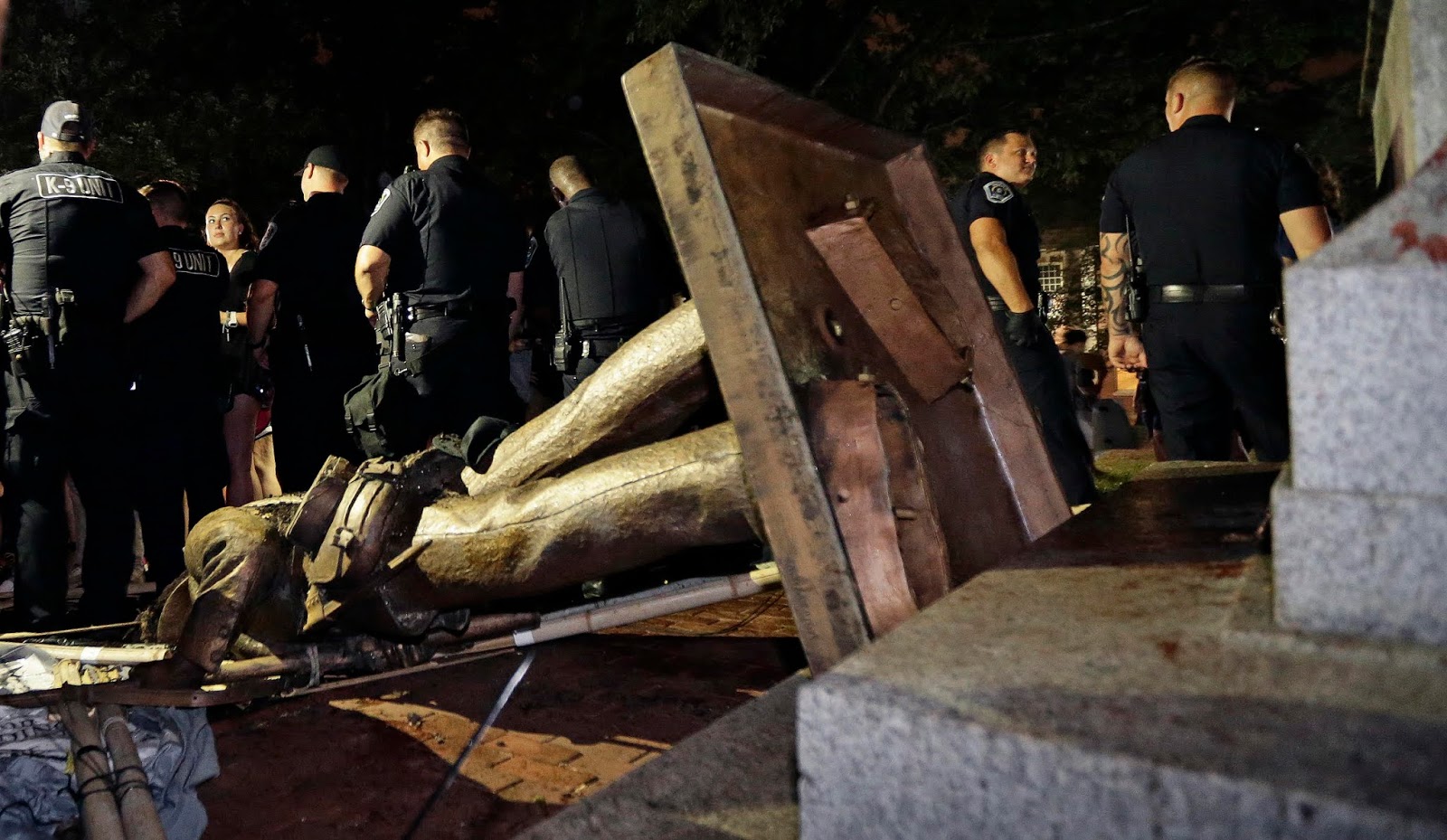
The granite pedestal on which Silent Sam, the white supremacy symbol at the entrance to UNC-Chapel Hill, used to stand got hauled away in the wee hours this morning, by order of Chancellor Carol Folt, who incidentally also announced she's leaving her post as chancellor at the end of this semester just ahead (we imagine) of an angry mob of UNC Board of Governors members with pitchforks and torches who apparently did not know that Chancellor Folt was going to resign and order that hunk of granite removed on the same Monday in January. The BOG is largely an adamantine bunch of Republicans, and many wanted that warped statue back up on that pedestal.

UNC BOG Chair Harry Smith was particularly outraged by Chancellor Folt's actions, perhaps because he was in the middle of conducting a phone-in meeting of the board when news of Folt's resignation reached him. The board was discussing "personnel issues," and it's no secret that some of the board were gunning for Folt. Perhaps her unexpected resignation was one of those "you can't fire me because I quit" moments. We don't know. But Smith was unamused: "We are incredibly disappointed at this intentional action," Smith said in a statement. "It lacks transparency and it undermines and insults the board’s goal to operate with class and dignity."

With class and dignity. Is that code?

Smith made his fortune selling and installing air filters, but he's also the owner of apartment buildings that rent exclusively to students, and he's been accused of trying to steer member campuses in the UNC system to build public-private student housing via a company he had "a relationship" with. Uh-huh.

Smith, described as part of "an aggressive conservative faction" of BOG members, took over as chair last July. That faction ran off UNC President Tom Ross. Then they ran off his replacement, Margaret Spellings. Now Carol Folt is leaving too. Harry Smith and his faction get to replace those people with their people, and how they ultimately decide to handle symbols of white supremacy hang in the balance, sort of like that granite pedestal. If they go all hardline, we trust it will be with class and dignity.

POSTSCRIPT
The UNC BOG has decided that Chancellor Folt will not be allowed to continue until the end of semester. She needs to clean out her office by January 31st, they said.


Monday, January 14, 2019

A Southern White Boy Tries To Show Other Southern White Boys "There's an Exit Ramp From Your Cultural Blindness"


On May 19, 2017, New Orleans Mayor Mitch Landrieu delivered a speech about why he ordered four statues glorifying the Confederacy removed from their public spaces. I think this speech may go down as one of the most profound of the 21st Century.


Over Christmas someone gave me Mitch Landrieu's new book, "In the Shadow of Statues: A White Southerner Confronts History," a book I viewed with skepticism because (1) it's written by a politician and that's often a drag and (2) I knew little of Mitch Landrieu's biography or his politics and doubted he had anything to tell me. I was wrong on both counts.

I feel a kinship with Mitch Landrieu. He's younger than I by many years, but I think we shared some defining history: We were both young in a South that we came to believe was on the wrong side of history. I was young when I decided it was a good thing the Confederacy lost the Civil War, and that thought, even held silently, isolated me from my own working-class culture.

Landrieu was more fortunate, since his father, Moon Landrieu, pioneered the opening up of city jobs for black people when he was also mayor of New Orleans. Mitch grew up in an enlightened white household and went on to become mayor in his own right and take a step that his father may never have imagined, the removal of those symbols of white supremacy that had been erected to maintain the fiction that the Civil War was about honor and gentility rather than about tearing the country apart so that some men could hold others in bondage.

I'm told that Landrieu wrote the speech above. I believe he also wrote "In the Shadow of Statues." (Maybe he had a ghost editor, but I don't think he had a ghost writer.) He's good with words but not in a flashy way. He knows who he is, what he believes, and can express the truth of the moment in clear, straightforward sentences that neither fake human connection nor try to imitate it. By both explicit comment and by implication, Mitch Landrieu may just be the foil for a Twitterman who knows not truth, who has never known it, and who can not speak it on any given day and certainly not under oath.

Saturday, December 08, 2018

Thom Goolsby Takes a Stand for Silent Sam


While administrators at UNC fear violence if they force Silent Sam back up on his plinth in the middle of campus (see last item, down-column), some hard-ass Republicans on the Board of Governors relish the idea of actually provoking a little violence, figuring it'll help their conservative brand with the Trumpists. And it would, too.

UNC BOG member Thom Goolsby of Wilmington issued a three-minute video denouncing the cowardice of the Board of Trustees -- to put Sam away in a separate building ... what the Holy Land o' Lakes Christ is that? It takes Goolsby over three minutes, because a two-minute video just wouldn't accommodate the full boil of his outrage.

Put that Civil War-glorifying statue back up on its pedestal at the entrance to campus and dare the hippies and anarchists and eggheads to come tear it down. Beat some pointy heads into a flatter pancake, if you have to, and force those Generation Z children to honor the sacred heritage of the rebellious South. "Clearly the law does not contemplate allowing criminal actors to dictate the placement of historic objects," Goolsby intones, a Cicero with a hard-on for Carthage.

"Goolsby implored people to call each member of the UNC Board of Governors and Board of Trustees demanding Silent Sam’s return to its original place" (WECT). But don't call Thom Goolsby. He's already a lead-pipe cinch for the hard-line. He contributed his bit to getting rid of UNC President Margaret Spellings, and when he was a state senator, he wanted to see executions restarted to thin out the housing on Death Row. Nice guy.

When You Hear "Thought Police," Better Get Your Hardhat


North Carolina Public Radio was reporting late yesterday that some "dozens" of Chapel Hill faculty are organizing a protest against the university's latest plan for getting rid of Silent Sam, that Rorschach Test for white power and "the Lost Cause" that fell on its face back on August 21. UNC Chancellor Carol Folt and her Board of Trustees proposed building a special $6 million "Center" to house Sam, where he can be properly "interpreted." Faculty objected (the faculty assembly voted overwhelmingly against it, in a toothless resolution), but in the main, faculty want the statue saved but put somewhere else, off that campus, like on a Civil War Battlefield or in a famous historic cemetery (others have suggested a hog waste lagoon).

Forget the faculty. Students -- many, many students -- see the plan as a tone-deaf preservation of the imagery (and hence the intent) of white supremacy. So how do faculty, inspired by students, plan to protest? By withholding grades this month at the end of the semester ... until Carol Folt and the Board of Trustees rethink their plan, and recant it. Withhold grades? Big deal? Well, yes, and UNC administrators are warning of "possible legal ramifications, including student lawsuits. Withholding grades could also cause issues for students graduating later this month."

For the big bosses, the overriding issue about returning Silent Sam to campus (al fresco), out in the open where students can gather to protest him, is the potential for violence, like what brought down Sam in August. Any time a student gets hurt on a public campus, you got much larger potential liabilities. So the admin decided to pay the money, build Sam a safe place where crowds can't gather to protest him -- and potentially turn violent -- and hope that manner of hallowing Civil War relics will placate the reactionaries. Sam gets his own reliquary, and maybe in 30 years his shiny bronze rifle will still get dusted.

The new building for Silent Sam was only part of the formal proposal by the UNC Board of Trustees.  Someone smart got quickly to reading "the appendices" to the Silent Sam plan, and that someone was AppState history professor Michael Behrent (hattip MM). What he found is classic over-reaction by rulers -- a proposal for militarizing all the campuses of the UNC system with a swat team -- "a mobile force platoon" is the verbatim language -- of 40 (yes!) specially hired and trained university white hats with batons, arriving ready to restore order.

Carol Folt with some UNC trustees
The Age of Trump: backward to authoritarianism.

Mobile Force Platoon was proposed by a "safety panel," a veritable “who’s who” of prominent police and military officials, who came up with this modest proposal at the request of the Board of Trustees (from Michael Behrent):
“...that the UNC Police acquire greater capabilities in the area of crowd control, protest management and intelligence gathering.” To this end, the panel calls for, as a way of addressing “large protests that involve unlawful behavior,” a “mobile force be developed at the UNC System level (to be shared by all System institutions).”
Would they arrive by helicopter, blowing dust into angry student faces? Or by big black van, an opaque wagon of retribution and backlash?

The item about "intelligence gathering" ought to raise neck-hairs, if not hackles. That means spying and with spying comes provocative incitement, followed by various punishments meant to clamp down on opinion. It's a bad idea.

Wednesday, August 22, 2018

Find a Better Place for Silent Sam


Photo: Khadejeh Nikouyeh, News and Record
So "Silent Sam" is down, the monument to UNC students who died in the Civil War, which was erected and dedicated by white supremacists on that campus in 1913. White supremacists? Yes, and if you don't believe it, you can read about the dedication speech made in 1913 by Julian Carr upholding the "Anglo-Saxon race in the south."

This morning, Washington Post reporter and UNC grad Eugene Scott published a little education for Southern white people -- "Most People Mad at the Removal of UNC's Silent Sam Don't Know What It's Like To Walk Past the Statue. I Do." I'm thankful for that perspective, and for the Charlotte Observer's editorial board essay published yesterday, "UNC Protestors Decide Not to Wait for Change. Good for Them." The final paragraph of that gutsy editorial:
What matters more this morning — to UNC students and others — is that Silent Sam is down. One more monument to racism gone. One more reminder that instead of waiting for change, sometimes you have to pull it toward you.
"Pull it toward you." The writer is referring to the actually pretty clever way the students brought the statue down without anyone getting hurt -- by ropes that were concealed from the view of police by large banners.

When last seen, Silent Sam was tied into the bucket of a front-end loader being carted off to reappear (?) in some other, more appropriate venue (we hope), as a relict or holy icon of the racial politics of 20th-century America.

Carolina Memorial,
Gettysburg Nat'l Military Park
I just came from the Gettysburg Battlefield where statues to Union and Confederate heroes are as thick as deer ticks. In fact, the Carolina Memorial is one of the more famous statues there, sculpted by the same man who carved Mount Rushmore. The faces of the soldiers he depicted are moving renditions of dedication and determination and pain. Those are wholly worthwhile emotions to memorialize on the battlefield where no doubt some UNC students perished protecting the right to own slaves. We can honor the pain without necessarily buying the economic forces that caused it.


Friday, August 10, 2018

My Civil War


I've only just been there -- to Gettysburg -- and now I'm obsessed. Maybe not obsessed in the way so many of my Southern brethren have always been obsessed -- with the hallowed names, the superior military breeding, the incredible bravery, the almost super-human sacrifice, and the ultimate heroic loss in "Lost Cause." That's nostalgia, like faith, the evidence of things not seen.

I'm obsessed with how close we came to losing our nation.

Joshua Chamberlain
Really, really close. Union General Dan Sickles single-handedly just about did it. But for the quick thinking of Col. Joshua Chamberlain of the Maine 20th -- you wanna talk bravery? -- the road to Washington would have been wide open for Robert E. Lee.

Today, the streets are crowded in Gettysburg and you meet people. Everyone's from everywhere. I met a young guy from Greenville, North Carolina (small world). He was with his wife and two very young children. He was a loud talker and an entertainer by nature, so other people heard him mention North Carolina, including me, and he noticed it and spiked that ball.

"I'm from North Carolina, but I guess you'd call me a Union sympathizer."

We fell in after that and discovered we were both reading the new Ron Chernow biography of U.S. Grant -- he was actually re-reading it -- big Grant fan. And you might call me a Grant sympathizer. So we were not your typical North Carolina boys in Gettysburg, maybe, and we found that amusing. Because we also heard grumbling in the Gettysburg National Military Park visitor center that the entire "public" history being practiced there was one-sided and did not appreciate the Southern point of view.

One woman from Florida -- a super-pleasant woman with an open face -- said to me, "Didn't you think that movie presented the battle from the Northern perspective?" I thought but didn't say -- because why be sarcastic and also because I probably would have run away on Day 1 -- "I thought it was the American perspective." 

At least the perspective of any country I would call home.

It is a good thing the Union won on July 3rd, 1863. A terrible thing too. It was all terrible. Horrendous. Suicidal. But it is a good thing that the country didn't split up. It was a good thing that slavery was abolished. It was a blessed thing that we had another chance to perfect our union.

So when I hear Southerners characterize the Civil War as a fight for cultural and individual freedom, I want to ask -- but won't, probably -- "freedom to do what, exactly? Please lay that out for me, as I've got a couple of basic questions."

Sunday, August 27, 2017

Them Monuments!

A friend (DS) sent me the speech made by Julian Carr at the dedication of Silent Sam, the Civil War monument on the campus of UNC-Chapel Hill, on June 2, 1913. The speech is preserved in the Southern Historical Collection at UNC as part of the Julian Carr Papers. He was a well educated graduate of the university, a Civil War veteran, an important post-war tobacco businessman, and a fluid, florid writer.

I just read that speech straight through with keen interest, thinking of the current controversy down there in Chapel Hill between the citizens who want that statue of Silent Sam removed, and the citizens who don't. Carr's speech illuminates the context for Silent Sam's placement on campus, at least insofar as Mr. Carr saw it. His speech was epic, flowery, decorated with high-flown allusions to mythology and ancient history, with frequent slabs of quoted poetry, and plenty of flattery for the Daughters of the Confederacy who had raised the money for the statue. The Daughters of the Confederacy were direct descendants of the Vestal Virgins of ancient Rome, said Carr, and added (I'm not making this up!), "God's name be praised!"

All those war dead, which the statue represented, got transported in Carr's speech from the actual slaughter on actual bloody battlegrounds, to this: "I know where they [the war dead] are, -- just over the narrow-river, camped in silken tents, on the green sward, under the shade of the trees, on the banks of the crystal stream of life" ... meaning, O my brethren, that even though those dead boys are all living it up in heaven, they're also still very much present for us and our Sacred Cause. (Boy! Would I like this guy to preach my funeral, and all funerals!)

The statue thus dedicated depicted a very much alive common Confederate foot soldier, clutching his rifle to his chest, and facing north, obviously, because the Union was the North, but also for another reason -- as a demonstration of that 1913 crowd's resistance to northern economic and political power. (The Union's military occupation of the South following the war was called "reconstruction" by Yankees, but among Southern white elites it was known as tribulation of the righteous.)

Facing north, also, as a symbol of resistance to what had happened in North Carolina very recently, and could happen again! Just 20 years before the arrival of Silent Sam, the Fusion Party -- made up of a coalition of Republicans and Negroes -- had swept the North Carolina elections of 1894 and 1896. Newly elected Fusion Party officials, some white and some black, immediately installed literally thousands of Negroes in low-level political and patronage jobs, further inflaming the hatred of white Democrats.

You know what happened. White Democrats fought back in the elections of 1898 with pure race war language and tactics and took back the government. Not incidentally, a cabal of Democrats in Wilmington, NC, in that same year staged an armed insurrection against their Negro city government, executing at least 20 Negroes (and possibly as many as 60), and torching Negro properties -- all for the race crime of being duly elected to office.

Julian Carr, 1905
Near the end of his speech, Carr got around to gingerly mentioning the race war context. He started off by wringing his hands rhetorically that current college students in 1913 didn't take seriously the Negro threat:
The present generation, I am persuaded, scarcely takes note of what the Confederate soldier meant to the welfare of the Anglo Saxon race during the four years immediately succeeding the war, when the facts are that their courage and steadfastness saved the very life of the Anglo Saxon race in the South. When "the bottom rail was on top" all over the Southern states, and to-day, as a consequence, the purest strain of the Anglo Saxon is to be found in the 13 Southern States -- Praise God.
When "the bottom rail was on top." There it is, his gingerly way of mentioning Reconstruction, when bottom blacks got on top. Carr continued with the most startling thing he said that day -- because it's personal and apparently true:
I trust I may be pardoned for one allusion, howbeit it is rather personal. One hundred yards from where we stand, less than ninety days perhaps after my return from Appomatox, I horse-whipped a negro wench until her skirts hung in shreds, because upon the streets of this quiet village she had publicly insulted and maligned a Southern lady, and then rushed for protection to these University buildings where was stationed a garrison of 100 Federal soldiers. I performed the pleasing duty in the immediate presence of the entire garrison, and for thirty nights afterwards slept with a double-barrel shot gun under my head.
Don't you wonder about his telling that story of beating a "negro wench" on that occasion, in front of that elite and pious crowd, and without apparent embarrassment? After all, he was bragging about beating that woman, to an audience he must have assumed would smile rather than wince.

With that crowd and at that time, it was perfectly okay, and perhaps even expected from an old soldier, to demonstrate that you'd never give an inch on race.

Tuesday, August 15, 2017

The Durham Civil War Soldier Statue

WRAL
I agree with Gov. Roy Cooper: There's probably a better way to do this.

Like getting these Civil War symbols off public land and into museums or private venues.

But this particular metal statue -- which stood there in front of the Durham County Courthouse since 1924, looking as solid as the Confederate dollar -- turned out to be a cheap (zinc?) hollow casting, part of a mass-production made during the first two decades of the 20th century to satisfy the politics of that time. The politics of that time have not aged all that well into the 21st Century.

Work of art or commercialized pop culture from the Jim Crow South?

These statues, or others like them, went up all over and by the hundreds in the first two decades of the 20th Century. (The McNeel Marble Works in Marietta, Ga., did most of the marble ones, the famous "Standing Soldiers" and other icons, but this statue in Durham was cheap pot metal.) At the turn of the Century, these statues were prideful reactions to Northern industrial superiority and reassertions of segregationist ideology -- "Jim Crow." The money was often raised by the United Daughters of the Confederacy, but sometimes local governments wanted to jump on board for obvious reasons.

In North Carolina particularly, that era followed the brief power of the Fusion Party, a coalition of populists and black and white Republicans who swept state elections in 1894, including putting approximately 1,000 black officials into office. US Congressman George H. White was one of them. The Democratic Party of that day was suddenly, conspicuously, and pretty much totally out of power everywhere in North Carolina. There's usually been a strong reactionary white wave against any conspicuous advancement of colored people (and those waves right up to the present often include traditional "Democrats" in the reactionary voting bloc). The Civil Rights movement in the '60s produced a Jesse Helms. The election of Barack Obama brought the Tea Party sweep of 2010. So can't you guess what happened at the turn of the 20th Century? Following two virtual landslides for Fusionists in the elections of 1894 and 1896, the Fusion Party was swept into oblivion in the election of 1898. Boom! Gone! And the broom used in the sweep was overt white racism:
In the 1898 “White Supremacy Campaign,” led by future U.S. Senator Furnifold M. Simmons (1854-1940), chairman of the Democratic Executive Committee, the Democratic Party used identity politics to regain power. “Negro rule” and “Negro domination” became the catchphrases of the campaign. Josephus Daniels (1862-1948), editor of the Raleigh News and Observer, was the unabashed press spokesman for white supremacy. Red Shirts, reminiscent of the Klan, intimidated blacks and thereby limited the number of Republican votes. (North Carolina History Project)
Okay, motivation is one thing, but a God-fearing and church-going populace that didn't have anything to do with putting up those statues is allowed to view them as an honored and important part of their history, speaking to sacrifice and pain and loss and not the rest of it. I certainly see the statues as part of history, too, and I haven't been inclined to bash history or attempt to erase it. The psychic juice released by the fantasy of "the lost cause" is powerful ju-ju and lives today for the Alt-Right too -- "You will not replace us!" The pious matrons of the United Daughters of the Confederacy lacked the wherewithal to question the true ingredients of that "cause," its antecedents, and its effects. I just don't know how much history the Alt-Right understands. (Well, it takes time to see yourself. We've all got our bubbles.)

The ideology of the white Democratic Party of 1900 and 1910 and 1920 has been spectacularly replaced in North Carolina politics by the Republican Party of 2010, 2012, 2014, and 2016, busying itself at knocking down and doing it like a raiding party of Vikings. Ta-Nehisi Coates captured very nicely the hidden agenda behind the "heritage not hate" argument: "The heritage of white supremacy was not so much birthed by hate as by the impulse toward plunder."

Wednesday, February 16, 2011

Wednesday Smorgasbord

1. Union County: "There'll be no memorial to 'loyal slaves' on our courthouse lawn." Decision NOT "based on race." No, never.

2. Sen. Kay Hagan pleased to join the pro-business Washington think tank, ThirdWay.

3. Democratic Party Chairman David Parker wants the Republican Speaker of the NC House to investigate a possible conflict of interest by Rep. Mike Stone of Lee County, who set the agenda for a closed-door meeting featuring presentations by video-gambling interests while profiting personally in his own grocery store from video gambling.

4. State government employees: We're working people, too!

Saturday, January 29, 2011

The Mudd of History

Am now reading James L. Swanson's "Manhunt: The 12-Day Chase for Lincoln's Killer," the meticulously researched and juicily detailed account of John Wilkes Booth's every movement immediately prior to and following the April 14, 1865, shooting of President Lincoln at Ford's Theater. Swanson has triangulated everyone's movements and actions from "letters, manuscripts, affidavits, trial transcripts, newspapers, government reports, pamphlets, books, memoirs, and other documents." It couldn't be more thorough, and it's as unput-downable as any thriller.

Reading about Dr. Samuel Mudd, the Maryland doctor who set Booth's broken leg early on the morning of April 15, I was surprised to learn that he was not a random stranger onto whose farm Booth blundered in the dead of night. Not only did Mudd already know Booth rather well, but Mudd also had joined Booth late in 1864 in a fantastic plot to kidnap President Lincoln and transport him south to the Confederate capitol in Richmond, Va.

Mudd was very much a part of the philosophical environment in Charles County, Md., at that time. That part of southern Maryland gave Abraham Lincoln a total of just six votes in the election of 1860, out of 1,197 votes cast. Mudd himself was "anti-Union, antiblack, and the owner of up to eleven slaves before emancipation freed them."

That being said, Mudd was evidently wholly innocent of any involvement in the successful plot to kill the president some six months after Booth had wanted to kidnap him. Mudd did, however, on April 15, 1865, and during the days following after he learned what Booth had done, conceal this knowledge from the authorities. And for that he was severely punished.

All of this brought back memories of an old 1936 movie I had seen as a farmkid in Texas, "The Prisoner of Shark Island," a total whitewash of Mudd's motives which conveniently also erased all of Mudd's prior involvement with John Wilkes Booth. The character of Dr. Samuel Mudd in that Hollywood movie was victim of Union tyranny, pure and simple. He's railroaded into a military trial for his life, barely escapes death by hanging, and is instead sentenced to a fate virtually worse than death, long confinement in the notorious prison on the Dry Tortugas. In other words, it was the perfect movie to stir the anti-government passions of a Southern pre-teen of that day. Which it did.

Having just finished Ulysses S. Grant's "Personal Memoirs," I already knew that the general was in Washington on the day of the assassination -- which came just five days after Lee's surrender at Appomattox -- and was actually supposed to accompany the president to Ford's Theater that night. That double appearance of the president and the Union's great general was known all over Washington that day, as the Ford Theater management put out handbills advertising the fact. But the general and Mrs. Grant changed their plans at the last minute.

FOOTNOTE ON THE MOTIVES OF ASSASSINS
John Wilkes Booth was not crazy. He was politically motivated. And he gathered a sizable group of co-conspirators around him who shared his radical anti-Union, pro-slavery views.

Thursday, January 27, 2011

Slavery and Southern "Memory"

Just finished reading "The Personal Memoirs of Ulysses S. Grant," all billion pages of it which was published originally in two fat volumes in 1885 (initially published by Mark Twain, incidentally).

I found myself a paperback copy of all billion pages when I was last in a Barnes & Noble, mainly because in my reading of modern histories of the Civil War, I kept stumbling on references to General Grant's Memoirs as one of the truly great reads in American literature.

They were right.

More than that, the man's "Memoirs" have completely changed my mind about him. I associated his name primarily with government corruption during his two terms as president (1869-1877). He bears the blame since he was chief executive and allowed certain men into office who generously helped themselves. The justification for that blame is another study altogether and not one I've undertaken or plan to undertake.

His writing about the Civil War is another matter, and he comes across as brutally honest (especially about himself), with a sharp intelligence and a quiet but active wit. He was no brute, which is also a part of the reputation I absorbed from somewhere.

I found this passage near the end of those billion pages:
The cause of the the Great War of the Rebellion against the United States will have to be attributed to slavery. For some years before the war began it was a trite saying among some politicians that "A state half slave and half free cannot exist." All must become slave or all free, or the state will go down. I took no part myself in any such view of the case at the time, but since the war is over, reviewing the whole question, I have come to the conclusion that the saying is quite true.

Slavery was an institution that required unusual guarantees for its security wherever it existed, and in a country like ours where the larger portion of it was free territory inhabited by an intelligent and well-to-do population, the people would naturally have but little sympathy with demands upon them for its protection. Hence the people of the South were dependent upon keeping control of the general government to secure the perpetuation of their favorite institution. They were enabled to maintain this control long after the States where slavery existed had ceased to have the controlling power, through the assistance they received from odd men here and there throughout the Northern States. They saw their power waning, and this led them to encroach upon the prerogatives and independence of the Northern States by enacting such laws as the Fugitive Slave Law. By this law every Northern man was obliged, when properly summoned, to turn out and help apprehend the runaway slave of a Southern man. Northern marshals became slave-catchers, and Northern courts had to contribute to the support and protection of the institution.

This was a degradation which the North would not permit any longer than until they could get the power to expunge such laws from the statute books. Prior to the time of these encroachments the great majority of the people of the North had no particular quarrel with slavery, so long as they were not forced to have it themselves. But they were not willing to play the role of police for the South in the protection of this particular institution....

Out of curiosity, I just Googled "Civil War not about slavery" to see what would turn up and was actually not at all surprised that a great deal of special pleading turned up, a concerted effort to erase slavery as the prime mover for the Civil War and replace it with reasons a good deal more high-minded and, incidentally, a good deal more flattering to those political forces of this day that are resisting our current president and his legislative initiatives.

Resistance is one thing. Mythological history to justify it is something else and quite debilitating to boot.

Saturday, January 15, 2011

Lotus Eaters

Thanks to BrotherDoc for sharing this essay about the striking similarities between the pro-secession drumbeat in the South in 1860 and the anti-government rants by the Tea Party in 2010.

The slave-holders of 1860 and the filthy rich of 2010 both managed to convince regular non-slave-holding and non-rich people to support their vested interests. And as BrotherDoc notes, they managed to do it in 1860 without Fox News.

But they did it with an emotional appeal to "freedom" and "liberty," one of the greater ironies of American history, since the "freedom" and "liberty" that the slave owners were trumpeting was the freedom to own another human being and work that human being to death at the end of a whip.

So Southern boys with no personal vested interest in slaves, since their families were small-holders and subsistence farmers with no personal human property, signed up by the tens of thousands to die really gruesome deaths on the battlefields of Shiloh and Vicksburg and Chancellorsville and Gettysburg (and in 10,000 other battles, large and small) to keep the slave-holding planter class comfortably invested in their ruling positions over Southern society.

(We've been reading "The Personal Memoirs" of Ulysses S. Grant, so the realities of the Civil War -- rather than the Southern myth of "the lost cause" -- are quite vivid at the moment. Hearing the constant drumbeat, especially out of South Carolina, that the Civil War was not about slavery just discourages us that our Southern homeland will ever face the truth of its own history. But we digress.)

Back to this thoughtful little essay:
The slaveholders were able to persuade other white Southerners to fight, kill and die for a cause that was, in fact, against their own interests. Slavery worked against whites who owned no slaves. They had to compete with those who had this cheap source of labor. Protecting slavery also made the South hostile to other reforms, including industrialization, that could have benefited less affluent whites.

This story line should sound familiar to us now.

What is happening in the nation’s political economy today is all too similar to what transpired a century and a half ago. The benefits now accruing to middle-class Americans from concentrating more and more wealth and power at the very top — like the benefits 150 years ago of slavery to non-slaveholding whites — can be measured in negative numbers. Unemployment remains high in large part because a consumption-based economy is dependent on a less inequitable distribution of income.

Once again, talk about putative threats to “freedom” and “liberty” is being used to scare ordinary citizens into acting in the interests of the wealthy, who are focused on their own concerns, not on behalf of the people they are stirring to anger.

True dat!

Thursday, December 30, 2010

Civil War Mythology and the Indoctrination of the Young

Headlines today about school history textbooks being taught in Virginia caught our eye, primarily because of the claim in those textbooks that "African Americans fought in large numbers for the South during the Civil War."

Funny claim, that. Made, obviously, to prove that slaves were really quite happy with their lot in the South, and when that way of life was threatened by the "Northern War of Aggression," they willingly picked up arms to defend Massa and the Missus against the Yankees.

I just finished reading a history of the Civil War ("The American Civil War: A Military History," by John Keegan: Alfred A. Knopf, 2009) and remembered that Keegan had some things to say about the participation of ex-slaves in the armies of the North ... and this bit following about certain proposals by some Southerners to force slaves into defending the South:
At the very end of the war, as the clouds of defeat began to gather over the Confederacy, there arose a mood even there to make good its growing shortage of manpower by enlisting slaves. The proposal to arm and train slaves as soldiers, advanced by General Patrick Cleburne of the Army of Tennessee in January 1864, found favour with many of his senior subordinates, who accepted his argument that black enlistments would greatly expand the South's fighting strength. Others, however, violently disagreed. Cleburne's proposal simply caused division and ill feeling until Jefferson Davis [president of the Confederacy] forbade its being further discussed or even mentioned. By November 1864, however, Davis called on the Confederate Congress for permission to purchase slaves to be used as military cooks and transport drivers .... [The Confederate] Congress, however, drew back ..., with the former presidential candidate Howell Cobb stating, "You cannot make soldiers of slaves or slaves of soldiers. The day you make soldiers of them is the beginning of the end of the revolution. If slaves will make good soldiers our whole theory of slavery is wrong."

Take time to think about how enlisting slaves to save the institution of slavery would expose the practice to ridicule. Cobb was right. Plus the Nat Turner slave rebellion in Virginia, which preceded the Civil War by a couple of decades, could still sent a shiver of fear down the backs of many Southerners who contemplated for even a second the thought of hundreds of slaves holding guns and bayonets.

General Robert E. Lee weighed in on the issue in February 1865, just a couple of months before his forced surrender to U.S. Grant. Lee wrote a letter to a Confederate congressman in which he concluded that "if the enlistment of blacks was the only means to avert defeat, then blacks must be accepted as soldiers."

Historian Keegan:
By March 1865, the Confederate Congress officially called on slave owners to make up to a quarter of the slaves in any one state available for military service. Eventually only two companies of black soldiers were enrolled, and they had taken no part in fighting before the Union army arrived in Richmond to impose surrender.

In other words, though moves were afoot to try to enlist slave soldiers to save the Confederacy during its death throes, only about 200 were ever mustered in, and those never took part in any battle.

So much for the bogus claim that African Americans fought "in large numbers" for the South.

Southern generals were justifiably worried about what sort of fighters coerced slaves would be. Black soldiers fought very well for the Union, incidentally, but they were literally and figuratively fighting for their individual freedoms. Ultimately, between 180,000 and 200,000 black men served in the Northern armies. Twenty-three of those soldiers won the Congressional Medal of Honor before Appomattox.