Showing posts with label Sam Ervin IV. Show all posts

Wednesday, October 19, 2022

Ervin v. Allen for the NC Supreme Court

Excerpted from PamsPicks.net


NC Supreme Court, Associate Justice, Seat 5

NOTE: You may vote for one. Candidates are presented below in the order they appear on your ballot.

Reason for my Endorsement: I believe it’s fair to say that if Allen beats Ervin and joins his rabidly conservative mentor Paul Newby on the court, then we’ll probably never see any unconstitutional action by the Republicans in the General Assembly overturned. While I wish there was a progressive alternative to Ervin, abortion rights, book banning, gerrymandering and voter rights are on the line and  half a loaf is better than no loaf at all.

Sam J. Ervin IV, Democrat

https://www.facebook.com/ervinforjustice

https://www.ervinforjustice.org

https://mobile.twitter.com/samjervin22
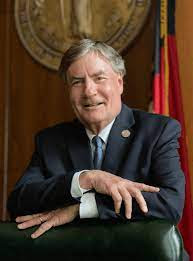
Ervin was elected as an associate justice on the North Carolina Supreme Court on November 4, 2014, winning a full term that expires on December 31, 2022. Prior to being elected to the North Carolina Supreme Court, Justice Ervin served on the North Carolina Court of Appeals from 2009 to 2015 and was a member of the North Carolina Utilities Commission from 1999 to 2009.

Ervin, IV attended the public schools in Burke County and graduated in 1974 from Freedom High School. He graduated magna cum laude from Davidson College in 1978, where he majored in history, and earned his law degree, cum laude, from Harvard Law School in 1981. 

Some Democrats are conditioned to expect Judge Ervin to be a “swing” vote on the state’s high court, meaning in my book, that he can’t be counted on to issue progressive conclusions of law. I am one of those Democrats, and I wish there was a progressive alternative to Ervin.

As an example, in one recent case, PHG Asheville, LLC, v. City of AshevilleErvin wrote the majority opinion that Asheville had improperly denied a developer’s application for a conditional use permit to build a hotel in downtown Asheville because “no competent, material, and substantial evidence was presented in opposition.” Which is blatantly false. As the excellent (and always progressive)  Anita Earls painstaking walks through in her dissent, Ervin willingly ignored it.

In some cases, however, Ervin has hung resolutely with the 4-member Democratic majority on such landmark issues as the unconstitutional gerrymandering of legislative seats for the General Assembly. In August, he was the fourth vote for a decision that said the state constitution can’t be amended by lawmakers if they come from districts with borders created in a racially-gerrymandered way.

The NAACP v. Moore case was filed in November 2018 in an attempt to invalidate two constitutional amendments: one requiring a photo ID to vote and one capping the state’s income tax rate. With its new opinion, the North Carolina Supreme Court said that members of the assembly coming from districts with unconstitutional racial gerrymandering could not propose amendments to the state constitution.

Ervin’s endorsements include, among others, NC Association of Civil Defense Attorneys, the North Carolina Association of Educators, the National Association of Social Workers, Planned Parenthood, the Sierra Club, and Equality North Carolina.


Trey Allen, Republican

https://www.treyallennc.com/meet-trey

https://www.facebook.com/treyallennc

https://twitter.com/treyallennc
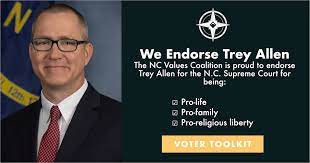
Allen was born in Robeson County. He obtained a bachelor’s degree from UNC Pembroke and a law degree from UNC Chapel Hill.

​Allen began his legal career as a judge advocate in the United States Marine Corps. He spent most of his time in the USMC overseas, and his military service included a deployment to Iraq during Operation Iraqi Freedom. As a judge advocate, he advised commanding generals and subordinate commanders on military justice and operational law matters, prosecuted violations of the Uniform Code of Military Justice, and helped fellow Marines resolve personal legal issues.

​After being honorably discharged, Allen completed a clerkship with Justice (now Chief Justice) Paul Newby of the NC Supreme Court. Following Newby’s installation as Chief Justice in January 2021, Allen was appointed General Counsel for the NC Administrative Office of the Courts.

Paul Newby is a bad cat and has wholeheartedly endorsed Constitutional conservative Allen. 

Allen’s other endorsements include “True Conservative Judges," Congresswoman Virginia Foxx, Senator Phil Berger, and GRNC.org, self-described as “boots on the ground to pass pro-gun laws and stop gun control.”


Sunday, January 28, 2018

The Wild, Wonderful Way That Judges Use the Language

Good Lord Almighty! Hell for me would be forever reading court documents in constitutionality cases in North Carolina.

I've got the blind staggers after spending much of the day on the text of Judge Ervin's decision in Roy A. Cooper v. Philip E. Berger and Timothy K. Moore, a landmark case, but gawd! the language, the terminology, the "magic words"! A tar-pit, if you'll forgive the all-too-obvious reference. Nevertheless, I've often been engrossed in it, and sometimes nonplussed. 

Phil Berger and Tim Moore.
It appears that "on its face,"
they fell flat on theirs
To boil it down: A three-judge panel appointed by Chief Justice of the NC Supreme Court Mark Martin especially to hear the governor's suit against the legislature last October -- in which the governor claimed that Berger/Moore violated the separation of powers provision of the state constitution in restructuring the boards of election and ethics and taking away the governor's ability to appoint the members of those boards as he pleases -- those three judges entered an order on Halloween Night, 2017, determining that it "lacked jurisdiction to reach the merits of the Governor's claims" ... leaving the General Assembly's power-grab in place and punting the issue to a higher court.

The Supreme Court caught the ball: "We'll take it from here."

I've learned a lot today about "the political question doctrine" and "justiciability," which was the foundation on which the 3-judge panel refused to act. LawBrain defines a "political question" as "an issue that the courts refuse to decide because it properly belongs to the decision-making authority of elected officials" and is therefore not a matter appropriate for court review -- "non-justiciable."

The NC Supreme Court did not agree with that reasoning and asserted its constitutional right to review the General Assembly's restructuring of the Board of Elections and Ethics and its cutting the governor out of the ability to appoint and control that combined board. It is not a political question, Ervin's decision asserts, because what the General Assembly did is also a fundamental violation of the separation of powers between the executive and the legislative branches of government, and on the face of it is an unconstitutional usurpation of power.

That's another word I've learned: facially. On its face. So obvious it hurts.

Much of the Cooper v. Berger and Moore decision focuses on the separation of powers and on the Supreme Court's ability -- nay, responsibility -- to test and check the General Assembly's power-grabbing ambitions -- the power of "judicial review."

Under that power, the Supreme Court yesterday reviewed what Berger and Moore did to the Board of Elections just hours after they watched a Democrat win the governship in the late fall of 2016 -- they combined elections and ethics enforcement boards and recomposed it with equal numbers of Democrats and Republicans, so that stalemate is all but guaranteed in matters like Early Voting plans in all the counties -- something we know about in Watauga -- and the Democratic majority on the Court found it just on its face an unallowable infringement on the executive:
The General Assembly cannot ... structure an executive branch commission in such a manner that the Governor is unable, within a reasonable period of time, to “take care that the laws be faithfully executed” because he or she is required to appoint half of the commission members from a list of nominees consisting of individuals who are, in all likelihood, not supportive of, if not openly opposed to, his or her policy preferences while having limited supervisory control over the agency and circumscribed removal authority over commission members. 
I can read that, and understand it very clearly, and so can Berger and Moore.

Friday, May 06, 2016

NC Supremes Bob Edmunds Must Face Challenger

BREAKING NEWS
Ruling  Stands: "Retention Elections," unconstitutional

The "retention election" law passed in 2015 -- overturned by a 3-judge panel as unconstitutional in Feb. 2016 -- will stay overturned because of a 3-3 tie today on the NC Supreme Court

Sabra Faires
Background
Last February, a special three-judge panel ruled in Sabra Faires et al. v. State Board of Elections et al. that the Berger-Moore innovation called "retention elections" was and is unconstitutional. The "retention election" law (passed quietly in 2015 to go into effect in 2016) effectively applied to only one human being, sitting Supreme Court Justice Bob Edmunds (R), up for reelection in 2016, because the retention election law mandated that any Supreme Court justice (and only a Supreme Court justice, on which, see below) up for reelection in 2016 (which would be Edmunds alone) did not have to run competitively against a known opponent but was subject to a voter plebiscite instead -- voters would vote only on whether Edmunds should be retained -- "yes" or "no" -- not on him or his known opponent. Under the Berger-Moore law, if by some fluke voters in the majority said "no," then the governor would get to appoint Edmunds' successor. Nice touch, that!

Sabra Faires, a lawyer in Raleigh who also wanted to run for Edmunds' seat, cried foul and sued on constitutional grounds: "retention elections" fundamentally violated the meaning of "election" as a choice. A special three-judge panel in Wake County agreed with her.

The State Board of Elections naturally appealed ... to the NC Supreme Court. The Supreme Court took the case. Interesting, since the retention election law, if it stood legal challenge, would eventually apply to the longevity of every last one of those justices, a clear conflict of interest. Edmunds, of course, recused himself. The remaining six justices split along partisan lines, creating an unbreakable tie of 3-3, Republicans Mark Martin, Paul Newby, and Barbara Jackson on one side, Democrats Sam Ervin IV, Cheri Beasley, and Robin Hudson on the other.

Bob Edmunds
When she spoke in Watauga on April 16, Sabra Faires said that she and the other plaintiffs did not make an issue of the conflict of interest (which plaintiffs could have, calling for a special and impartial panel). With Edmunds recused, it seemed pretty predictable that the court would tie 3-3, which would mean the lower court ruling would stand.

Bottomline
There will be an election in November between Bob Edmunds and whoever comes out on top in the primary June 7th: Sabra Faires, Daniel Robertson, or Mike Morgan. Take a guess who I'm voting for.

Footnote: Why the Retention Law Applied to Supreme Court Justices Alone
Berger Family Values
The original draft of the retention election law included all appellate level judges, meaning both NC Court of Appeals judges and Supreme Court judges. Written to include the appeals court, the law would have ruled out Phil Berger Junior's ability to challenge Linda Stephens. If she were "retained" under a new law, Junior Berger would be shit out of luck.

Phil Berger Senior, who runs Republican government in Raleigh, changed the law to apply only to the Supreme Court, and paved the way for his son.

Wednesday, May 07, 2008

Winners, Losers, and Big Losers

Say it once and don't say it again: it was a very big night for the Barack Obama campaign, a disastrous night for Hillary. And can we put aside the supposed black/white gulf, when lily-white Watauga County went for Obama by a greater percentage than the rest of the state? This despite the stumping of Bubba through our neck of the woods. Buncombe County, which hosted visits by all three Clintons, went for Obama by over 54%. So much for the "Clinton magic" in western North Carolina (and in rural America generally).

Other Big Winners
Walter Dalton, who won outright in a four-way race for the Democratic nomination for Lt. Gov. Just about everyone was predicting a run-off.

Pat McCrory, who won outright in the Republican primary for NC Gov. Beverly Perdue has now a far tougher row to hoe.

The 40+ NC mayors, including Boone's own Loretta Clawson, who endorsed Barack Obama.

Losers
Republican Appeals Court Judge John Tyson, who was knocked out in this primary by two Democratic candidates, who will now have to face each other in November: Kristin Ruth and the grandson of Sen. Sam Ervin.

Poor Fred Smith, whom we were rooting for, who proved (once again?) that free barbecue can't compete with expensive political consultants.

Congressman Patrick McHenry, who though he beat back the challenge from fellow Republican Lance Sigmon, appears to be damaged goods and must now face a gen-you-wine military hero in Democrat Daniel Johnson come November. Sigmon said prior to yesterday that he would never endorse McHenry.

Jerry Butler. What's the deal with Jerry Butler? Why did his home county of Watauga not vote for him in his win in the Republican primary for the NC-45 state senate race? Inquiring minds want to know what the home-town Republican voters were thinking.

Big Losers
Linda Daves and the North Carolina GOP. Their big negative ad against Obama -- the "eeek, a scary black man" TV spot -- did not work in a state where it might predictably have had some effect. Not only have the state Republicans looked craven and desperate to a national audience; they've also effectively slammed the door on reaching out to under-30 voters, who (1) can't countenance the theatrical incompetence of the Bush administration and (2) have apparently grown more mature than their tiresomely racist elders in the South.