 The arrest Friday night of five Appalachian State University students and one non-student member of the local community caps a year-and-a-half struggle by a local chapter of United Students Against Sweatshops to get the university administration to take action to insure that none of the souvenir apparel items bearing the university’s insignia is sweatshop-produced.
The students want the university to sign on to the "Designated Suppliers Program" (DSP), which is affiliated with the Workers Rights Consortium and is dedicated to ensuring that apparel made with university logos is produced under humane conditions. As of the first of March, some 181 American colleges and universities have affiliated, including Duke University and UNC-Chapel Hill.
We won't go into the evils of sweatshop labor here, except to point out that Appalachian State University claims it has taken steps to avoid the use of it through membership in something called the Fair Labor Association, which the United Students Against Sweatshops considers a sham org dominated by big corporations (like Nike) and which offers "a weak code that fails to provide for women's rights, a living wage, the full public disclosure of factory locations, or university control over the monitoring process."
Background to the Arrests
The local chapter of United Students Against Sweatshops (USAS) launched its "Sweatfree Campus Campaign" in the fall of 2006. Local students did research on the licensees of ASU-sanctioned clothing and presented it to Chancellor Ken Peacock, along with information on the DSP. In the subsequent meeting with the chancellor, the students realized that he had not read the material, "so the meeting was spent explaining concepts to him."
After that initial meeting, Chancellor Peacock appeared to lose interest in the students' concerns and delegated his "chief of staff" Lorin Baumhover to meet with them. Baumhover, according to the students, was antagonistic from the beginning, saying that USAS needed "scholarly research" to prove that DSP monitoring works and that the students needed to prove to the administration that they had campus-wide support.
The students went to work. They produced a 50-page research packet and delivered it to Chancellor Peacock's office and successfully lobbied both the SGA Senate and the Faculty Senate to pass resolutions in favor of dropping the university's affiliation with the Fair Labor Assn. and affiliating instead with the DSP (the SGA legislation, SB 040-005, is here, and Faculty Senate Res. FS 06-07/04-30-01 is here). The student government and faculty senate actions were taken in the spring of 2007 -- ironic, since by April 2007 Chancellor Peacock had ceased to respond at all to USAS e-mails.
In August 2007, Lorin Baumhover brought university attorney Dayton Cole to a meeting with USAS representatives. Attorney Cole made his case that DSP actually violated anti-trust laws, a point the students could counter with numerous legal opinions to the contrary written by the D.C. law firm of Baker & Miller (available here on the Workers Rights Consortium website), and besides, the students' proposal to Chancellor Peacock contained the proviso that ASU would adopt the program only AFTER the U.S. Dept. of Justice had determined the legality of the DSP.
Through August into September 2007, repeated e-mail and phone attempts by USAS to speak directly with Chancellor Peacock were met by silence.
The Students Get Creative
At the September 6, 2007, Convocation, which featured immigration expert Paul Cuadros, USAS was ready and unfurled a huge banner in the Holmes Center urging the university to take action on guaranteeing that sweatshop labor did not go into the production of ASU apparel. Several thousand ASU freshmen were thus informed for the first time that there might be a problem with the top administrators at their institution.
On October 3, 2007, USAS participated in an "international day of action" by covering the Yosef statue with tin foil and erecting a sign: "Sweatshops Reflect Poorly on ASU." The students also delivered a giant fake check for 25 cents, made out to Ken Peacock, to the chancellor's office, a visual representation of what the students say would be the retail price increase on a T-shirt made by a worker earning a living wage. The students also asked, again, for the Chancellor to make a decision on the DSP proposal.
Lorin Baumhover finally responds to student e-mails, says the only possible time to meet with them is during final exams for the fall semester.
Chancellor Peacock makes, then breaks an appointment with three-hours' notice on Dec. 5, 2007. Then on the next day, Dec. 6, Peacock gives over the students once again to his chief hatchetman Lorin Baumhover and the university attorney Dayton Cole. The students are told that ASU refuses to participate in the DSP. Furthermore, they feel that Dayton Cole is lying to them by "fabricating nonexistent legal opinions to support ASU's position."
January 23, 2008, USAS participates in another "day of action," presenting a framed "Certificate of Disappreciation" to Chancellor Peacock.
February 14, 2008, Valentine's Day, the Chancellor's office is treated to an "international phone and e-mail bomb" urging him to sign on to the DSP. ASU students drop by Peacock's office to deliver handmade valentines. Chancellor calls an emergency meeting with USAS, refuses once again to adopt their proposals but agrees "to reopen negotiations." Follow-up e-mails from USAS to Peacock thanking him for the meeting and asking to move forward on his promise to reopen negotiations go unanswered.
March 20, 2008 ... silent rally at Peacock's office to symbolize his silence and failure to follow through on his promise for open dialogue.
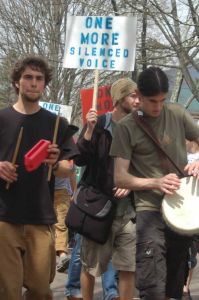
Wednesday of this week, April 9, noon: while a large group of students rally for DPS outside the administration building (the photo above, taken by Clair Baxter for The Appalachian), a small delegation enters the chancellor's office for a non-violent protest sit-in. Within minutes University cops arrive with hand-cuffs, Tasers, and other implements of enforcement and tell the students they will be arrested if they don't leave.
The students leave but go downstairs to the interior lobby, a public space they say they intend to occupy until Chancellor Peacock meets with them. University cops say they will be arrested when the building closes at 5 p.m. But they are not arrested, and the building is locked. Some nine students spend the night in that lobby. The next day, Thursday, other students join the protest, which continues uninterrupted through Thursday night and all day Friday, with a varying number of students participating at any one time. Several university cops babysit them through the vigil.
Suddenly, Friday night about 7 p.m., the six individuals then present in the administration building are arrested, hand-cuffed, and taken to a local magistrate and booked for trespass and disorderly conduct. They were freed on bail shortly afterward.
Why would ASU wait until Friday night for the arrest? One of the sit-in organizers thought it might have something to do with Saturday's planned open house for prospective freshmen. Several thousand high school students and their parents are on campus today, and it just wouldn't do for them to see civil disobedience going on at the admin. bldg.
More on this as we learn more.
ADDENDUM: Chancellor's Official Statement:
To the Campus Community
From Chancellor Kenneth E. Peacock
April 11, 2008
"I am very disappointed in the outcome of the United Students Against Sweatshops
action in the Administration Building this week. Despite our many attempts to
have productive dialogue and offer compromises to the students involved, our
every effort was rejected and we were forced to deal with the realities of the
university resources required to allow them to continue to stay through a weekend.
Because our only legal recourse to deal with students refusing to leave the
building was to place them under arrest for disorderly conduct, we were forced
to take that step. Vice Chancellor for Student Development Cindy Wallace
explained the situation to the students prior to that action being taken and
warned them of the ramifications of having an arrest record and violating the
Student Code of Conduct. Those students who chose to continue to stay were
informed of their rights, arrested and led out of the building.
My greatest regret is that, at the end of the day, there has been no positive
movement toward addressing the very issue the students say they want to address.
This group has had multiple meetings with both my representatives and myself in
the last six months and I provided them with a written response to their
concerns on March 19. We also have been in consultation with the other campuses
in the UNC System and no other institution has accepted their demands.
The University's commitment to seek and follow policies and programs that are
both lawful and effective in eliminating sweatshops remains steadfast and we
will continue our membership in the Fair Labor Association, which has been
promoting safe and healthy production and labor practices for many years.
Appalachian State University works diligently to ensure that our licensed
products meet acceptable standards. It is clear to me that these students and
the University have those goals in common. Our only disagreement is a difference
of opinion in how to achieve those goals most effectively. We have repeatedly
assured the students that if they have information regarding illegal or
unacceptable practices by any company producing items for Appalachian we will
immediately investigate and take appropriate actions. We have yet to receive
any information from the students in that regard so their claim that Appalachian
supports sweatshop labor is unsupported.
I hope this dialogue with the students can continue in a more productive format
and with mutual respect for the time of everyone who has been involved. I also
hope that we can move forward without the students continuing to resort to
tactics that interfere with the day-to-day operations of the University and the
Chancellor’s office that must be conducted on behalf of our students, faculty
and staff."