Showing posts with label Appalachia. Show all posts

Wednesday, January 05, 2022

The Continuing Rise of J.D.Vance


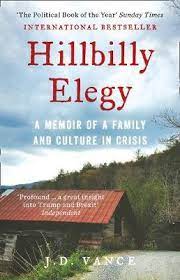
J.D. Vance became famous -- bankable -- after publication of Hillbilly Elegy in 2016. Seems like everybody was reading it back then. Many praised the beauty of the writing. Others actively hated it.

All the regional Appalachian activists I know, and the academics teaching or writing in the large field of "Appalachian Studies," spat nails about it. Still do. They told me in many conversations that Vance's autobiography about growing up poor and "Appalachian" in Ohio presented the grossest of generalizations about a culture built to sink without protest into despair. When the movie version came out in 2020, directed by Ron Howard, the push-back against Vance's generalizations about Appalachian culture grew even shriller. 

I confess that I never read the book and I avoided the Netflix film. I took my friends' word for it (always a dangerous proposition, but hey! I'm busy). No matter how vibrantly, sharply written, no matter how perfectly scripted for the Hollywood treatment, Vance's version of reality has outlasted its shelf-life.

So I'm primed to sneer a little at J.D. Vance, especially after he became a vocal Trumpist and declared he was running to replace Rob Portman in the US Senate from Ohio, financed in large part by libertarian billionaire Peter Thiel. I wrote disapprovingly last March about how Thiel, a kind of cultural snarling dog, really, was trying to buy Vance a Senate seat with $10 million. Meanwhile, Vance the cherub-cheeked pudge of a new author of 2016 (who looked like this back then)...
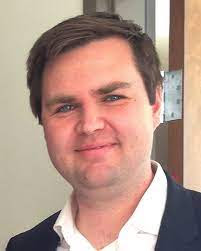


is now campaigning for the US Senate as a different sort of avatar -- angry-guy Trumpist J.D. Vance:
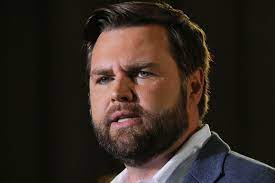


That change in persona -- from a Harvard-educated intellectual who "came across as guileless, boyish" -- to "playing Don Jr. on the Internet" -- that transformation becomes major grist for an amazing piece of in-depth analysis by Simon van Zuylen-Wood in yesterday's Washington Post, "The Radicalization of J.D. Vance."

Let’s start with the beard. J.D. Vance didn’t used to have one. The Vance who in 2016 achieved incandescent literary fame with his memoir “Hillbilly Elegy” was all baby fat and rounded edges. The Vance I’m watching now, from the back of a coffee shop in the depressed steel town of Steubenville, Ohio, has covered up his softer side.

One of Vance's friends told van Zuylen-Wood that the change in Vance was more than just outward appearance: “He’s going for a kind of severe masculinism thing. He looks like Donald Trump Jr.” Van Zuylen-Wood followed Vance on the campaign trail and verified the attempt to portray a bullying masculinity, though it often looked inauthentic: "Watching Vance campaign, I felt him straining to deliver his talking points in an angry register." Plus Vance's "shit-posting" on social media, which is "the signature style of young radicals on the right." Elegant writing be damned when you're trying to impress the Trumpists.

If you need to play to the Trump base — which Vance suddenly, desperately, needs to do — it’s not a bad idea to do so via online trolling: “You can own the libs without going on long paranoid spiels about all your enemies within the Republican Party who have failed to steal the election for you.”

Which leads to the central question behind this long profile: Is Vance a changed or a fraudulent person?

During the 2016 presidential campaign, Vance was known as a never-Trumper, so his cutting remarks about Donald Trump back then are being resurrected now by his Republican primary opponents. "Every campaign stop he makes, he patiently tries to explain away his past Never-Trumpism, which has been exhumed in the form of deleted tweets and Charlie Rose clips. An attack ad playing his anti-Trump sound bites ends with a woman saying, 'That’s the real J.D. Vance.' ”

I could go on grabbing quotes from this delicious article, past anyone's patience for taking it all in, but in answer to whether Vance's transformation amounts to fraud or a genuine change of heart, van Zuylen-Wood writes this hell of a paragraph:

Vance’s new political identity isn’t so much a façade or a reversal as an expression of an alienated worldview that is, in fact, consistent with his life story. And now there’s an ideological home for that worldview: Vance has become one of the leading political avatars of an emergent populist-intellectual persuasion that tacks right on culture and left on economics. Known as national conservatism or sometimes “post-liberalism,” it is — in broad strokes — heavily Catholic, definitely anti-woke, skeptical of big business, nationalist about trade and borders, and flirty with Hungarian prime minister Viktor Orban. In Congress, its presence is minuscule — represented chiefly by Sens. Josh Hawley and Marco Rubio — but on Fox News, it has a champion in Tucker Carlson, on whose show Vance is a regular guest. And while the movement’s philosopher-kings spend a lot of time litigating internal schisms online, the project is animated by a real-life political gambit: that as progressives weaken the Democratic Party with unpopular cultural attitudes, the right can swoop in and pick off multiracial working-class voters.

That's the kind of paragraph that deserves its own long profile. And there's much else in van Zuylen-Wood's reporting, especially on the intellectual underpinings of "national conservatism" (Peter Thielism) that incidentally indict classical liberalism for its own blindnesses and bland assumptions.

Friday, December 31, 2021

The Family That Did So Much to Destroy Appalachia


I just finished the first of my Christmas books, "Empire of Pain" by Patrick Radden Keefe, and I'm a little agitated by the confirmation that the Sacklers of OxyContin fame have indeed "gotten away with it." None of that large connected clan of three generations of pill pushers -- none of them have ever been materially punished for their part in literally creating the "opioid epidemic," while benefitting outrageously from the human destruction. 

Okay, footnote: The Attorney General of Massachusetts, Maura Healey, named Purdue Pharma and individual Sacklers in a civil complaint in June 2018 that ran to over 270 pages, but the Sacklers successfully blocked her by putting Purdue Pharma into bankruptcy. So I incidentally learned -- surprise! -- that when a company is in bankruptcy, all other suits and complaints against it are put on hold. I didn't know that. But it's key to why the Sacklers haven't paid personally yet for their ethical and moral crimes. 

However, they have begun to pay in humiliation. Some of the museums that they funded lavishly and which put their names prominently on display, like the Sackler Wing at the Met, have been chiseling those names off its granite. Some cultural institutions, which in the past have received millions in philanthropic money from various Sacklers, have now begun to say "no thanks, cause we don't want to be associated with you people any more." The Sackler's poor, exploited, milked company, Purdue Pharma, suffered plenty. It's been charged and fined as a corporate entity and some of its executives (who were most assuredly not Sacklers) got sentenced, and it's now a shell in bankruptcy court. None of that destruction touched the Sacklers personally, nor the bulk of their money.

Here's the thing that allowed the Sacklers to become celebrated philanthropists: For many, many years, the elite crowd in NYC and the mavens of major institutions, like the Met, Harvard University, Oxford, the Louvre -- they simply didn't know (and perhaps didn't want to know) how the Sacklers were making their money. The family had always been secretive. They obscured the connection between themselves and the marketing of pills --  especially after OxyContin became a hot topic.

The Sacklers have evaded accountability through a combination of ruthless tactics, highly paid lawyers, a willingness to go after anyone publicly complaining, and fat influence at the highest levels of government. I think it's fair to say that the Sacklers in the now three generations of the family effectively corrupted the regulatory obligations of both the FDA and the Department of Justice. Family bosses knew how to compromise a federal regulator by offering him/her a desk and a big salary at Purdue if they ever got tired of low-paid government work. At the right moment, the Sacklers knew key people in the Department of Justice (particularly during both the George W. Bush and Trump administrations), when Justice should have been seeking justice for false advertising and various types of fraud. 

Instead, billions (that's no exaggeration) were going directly into the pockets of the Sacklers (and into off-shore accounts where the government can't reach it). Profit from OxyContin soon passed $3 billion a year. Meanwhile, for the overdosed dead, the Sacklers showed little sympathy. Drug addicts were the "scum of the earth" who had only themselves to blame for their addictions.

Rep. Jim Cooper (D-Tenn.) a most mild-mannered, bowtie-equipped member of Congress, said this to David and Kathe Sackler, when they testified in a Congressional hearing titled "The Role of Purdue Pharma and the Sackler Family in the Opioid Epidemic":

"Watching you testify makes my blood boil. I'm not sure that I'm aware of any family in America that's more evil than yours."

Reading Keefe's book brings me to the same place.

In that Congressional hearing, the two Sacklers (Kathe representing the "A Side," descendants of the middle of the original three brothers who started the company; David representing the corporate "B Side," descendants of the youngest of the three original Sacklers) had just told Rep. Cooper and the other members of the committee, in sometimes testy tones and always with a billionaire's aplomb, an inability to read the room, that they did not know that OxyContin was addictive, that they had not and never would do anything wrong in the making and marketing of any medication, and why are you people persecuting the inventors of a medical miracle for pain control?

Keefe reports opinions that Richard Sackler, the inventor and prime marketer of OxyContin, simply lacked empathy. Had no understanding of and hence no sympathy for the suffering of others. If you're looking for a mortal flaw in not just Richard Sackler but in the whole corporate enterprise, "lack of empathy" will suffice. (We've had plenty of experience very recently with that type of human being.)

Hulu's "Dopesick" First Made Me Curious About the Sacklers

I really wanted to read "Empire of Pain" to learn about Richard Sackler in particular. I was riveted by actor Michael Stuhlbarg's portrayal of him in the Hulu series "Dopesick." Very good series. Focuses on the hills of Appalachia in Virginia, which was indeed the birthplace of Victim Zero, the first recorded death from OxyContin overdose. That drug (and then heroin, when there was no Oxy) ravaged Appalachia starting in 1996, and it's only fitting that "Dopesick" the series chose locations in Clifton Forge and other Virginia small towns for filming. The Virginia Museum of Fine Arts in Richmond served as the famous "Sackler Wing" at the Metropolitan Museum in NYC. Robert Gipe, a brilliant comic writer out of Harlan County, served as a script advisor. "He vetted every single detail," said writer Beth Macey, who had published the book "Dopesick." She signed on to write and help produce the Hulu series and wisely set aside her own bestseller to write a much broader script that went way beyond the local reportage that she had done for the Roanoke Times. 

Michael Stuhlbarg as Richard Sackler,
in the Hulu series "Dopesick"

Keefe's "Empire of Pain" must have supplied much of the Sackler history that Macy used in her script. All the stuff about those contentious Purdue board meetings, with the A Side and the B Side sniping at one another from opposite ends of a very long table -- all that came out of Keefe's book.

After watching the Hulu series (with Stuhlbarg's malign mystery as Richard Sackler), I got my hands on Macy's bestseller first (hattip JDG), hoping she was the source about the Sacklers. But, no, Macy's book is strictly reportage about the people of southwest Virginia touched by the opioid epidemic, particularly the families of the dead. In the TV series, the Michael Keaton character (the doctor who himself gets addicted) and the young woman coal miner and her family -- those are made up amalgamations of many people Macy had known, or known about. Meanwhile the Sacklers barely get a mention, nor do the various government lawyers dogging them and amassing a case against them, like the lawyers out of the Western District of Virginia and the FDA official played by Rosario Dawson. Macy's book goes into none of that, but Patrick Keefe does.


Sunday, December 04, 2011

Barbara Kingsolver at Occupy Johnson City

The best American writer in spitting distance of Boone (she lives near Emory, Va.), Barbara Kingsolver, went looking for Occupy Johnson City just over the mountain from here, and she found it and wrote this report, from the ineffable "Appalachian" perspective:
"...I saw some American flags and a sign that said 'God Hates Banks' and figured this had to be it. From across the street I heard one person say a few words at a time, repeated by the crowd in the unmistakable 'from this day forward…' cadence of a wedding or a swearing-in, and again I wasn’t sure I was in the right place. As it turned out, the call and response was the people’s microphone, famously re-invented in New York to subvert the ban on amplifiers. Here in Tennessee it sounds like people taking vows. Repeat as one: men in UMW jackets, farmers in their town clothes, college kids, retired schoolteachers, young couples pushing strollers, the wilderness guide in a kilt, the homeless man with the sign in Latin. Really the temptation was to ask any given person, what is the story? Because there is one. This is Appalachia, home of the forested Cumberland and Wildwood Flower and NASCAR and 18% unemployment and bless your heart. Home of mountaintop removal, wherein coal companies find it profitable to tear the earth’s own flesh from its bones and leave the stunned, uprooted living to contemplate drinking poison, in the literal sense. Birthplace of the Blair Mountain rebellion, where underpaid labor ran up against big capital in an insurrection unlike any other this country has known. That was in 1921, and by many accounts the approval rating of big capital here has not improved. Just this month, a dispassionate Wall Street analysis ranked us the fifth-poorest region in the land. The people’s microphone in this context sounds like a tent revival. It took twice as long to say anything, but induced full participation, which is also very southern, come to think of it. At length we agreed to march ourselves down State of Franklin Street, and as we stretched across block after block of stopped traffic, people in their pickups and dinged-up station wagons and gas-conscious sedans honked and cheered to see our 'tax greed' signs, and did not advise us to get a job or a haircut. The orthodox objections have grown ridiculous. Every system on earth has its limits. We have never been here before, not right here exactly, you and me together in the golden and gritty places all at once, on deadline, no fooling around this time, no longer walking politely around the dire colossus, the so-called American Way of consecrated corporate profits and crushed public compassion. There is another American way. This is the right place, we found it. On State of Franklin we yelled until our throats hurt that we were the 99% because that’s just it. We are."

Friday, October 10, 2008

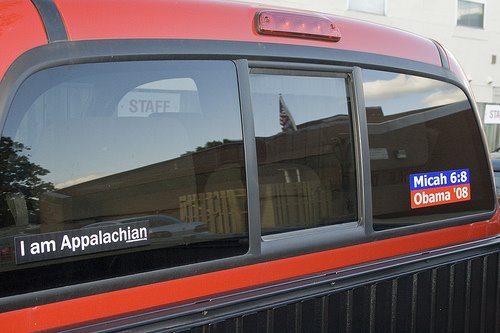
I Am Appalachian

Photograph purloined from Revolution in Jesusland, shot in southern Ohio.

Micah 6:8, incidentally, from the King James Version: "He hath shewed thee, O man, what is good; and what doth the LORD require of thee, but to do justly, and to love mercy, and to walk humbly with thy God?"